The pursuit of ultra-low DDR5 memory latency has reached a new frontier with the emergence of specialized overclocking profiles. AMD EXPO Ultra Low Latency is engineered to extract peak performance from Ryzen-based systems by slashing the response time between the CPU and RAM. However, the chasm between corporate ambition and market reality has proven unexpectedly wide. While the actual performance gains remain marginal, the prohibitive cost of entry transforms this hardware into a luxury commodity.
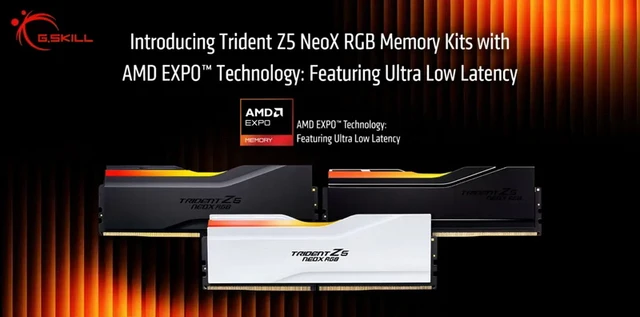
At Computex 2026, AMD debuted EXPO Ultra Low Latency (ULL), a refined overclocking profile standard engineered to aggressively drive down memory latency. According to the developer, implementing these profiles can yield an average gaming performance uplift of approximately 4% compared to standard EXPO solutions. In the current gaming landscape, where the battle is fought over every single frame and the stability of frame times, such an optimization is attractive, if not revolutionary.
AMD’s optimism extended to the price point, with company leadership suggesting that ULL-supported modules would not command a significant premium over their predecessors. However, initial market offerings from G.Skill revealed a starkly different pricing strategy, transforming a technical optimization into a tool for aggressive market segmentation.
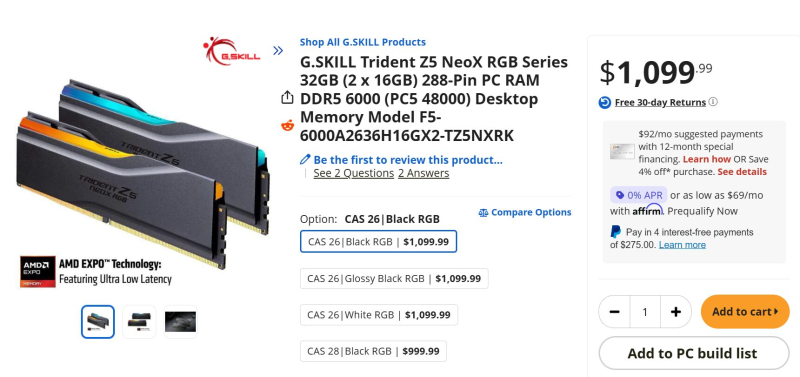
This pricing disparity is most glaring within the Trident Z5 NeoX RGB lineup. A 32GB DDR5-6000 kit with extreme CL26 timings is priced at a staggering $1,099.99. By comparison, a Trident Z5 Neo kit with identical frequency and primary timings—but a standard EXPO profile—retails for $699.99. This represents a 57% surcharge for ULL support.
The gap widens further with the CL28 variants: the NeoX is listed at $999.99, compared to $559.99 for the standard version. In this instance, consumers are asked to pay a 79% premium for a profile that is, essentially, a firmware-and-hardware layer atop an existing standard. While the price delta becomes less dramatic as latencies increase (CL30 and CL36), it remains substantial, cementing the NeoX’s position as an ultra-premium product.
The technical superiority of the NeoX modules stems not only from primary timings but from the deep optimization of sub-timings. The critical metric here is tRAS: while standard modules with CL26, CL28, and CL30 latencies typically feature a tRAS of 96 cycles, the NeoX series slashes this to 32. Even in the less aggressive CL36 kit, tRAS drops from 96 to 76 cycles.
Such a drastic reduction in sub-timings points to more rigorous chip binning, ensuring stability at lower latencies. Interestingly, for the CL26 and CL28 models, this was achieved while actually lowering the operating voltage to 1.35V (down from 1.40–1.45V in standard versions), which theoretically reduces thermal output and enhances overall system reliability.
However, unlocking this potential requires more than just a costly hardware investment; it demands full ecosystem compatibility. Activating EXPO ULL profiles necessitates a motherboard with native support and the latest BIOS revision.
Ultimately, AMD’s initiative to democratize ultra-low latency has collided with cold market logic. A technology that could have established a new baseline for accessible overclocking was swiftly co-opted by memory manufacturers and retailers to carve out a new elite tier. The end user is left with a stark dilemma: a modest 4% performance uplift in exchange for nearly doubling their expenditure on RAM.
 The Dawn of the 2nm Era in the New iMac