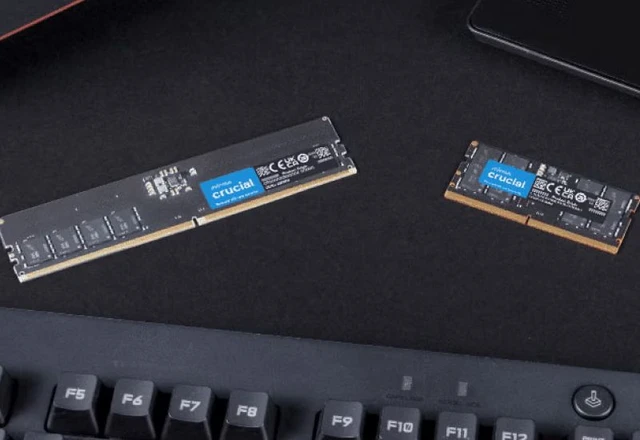
RAM is no longer a mere supporting act; it has evolved into one of the most significant investments in a modern PC build. In the relentless pursuit of peak performance, enthusiasts are often caught in a classic trade-off: prioritizing blistering clock speeds or opting for uncompromising capacity. Dual-rank module architecture is particularly noteworthy in this context, promising enhanced parallelism, albeit at the cost of increased strain on the CPU's integrated memory controller. An analysis of the flagship G.Skill Trident Z5 Royal kit reveals exactly where the line is drawn between opulent aesthetics and genuine technological superiority.
Over the past two years, the components market has undergone a peculiar evolution: DDR5 has shifted from a standard upgrade path to a luxury commodity. Today, a high-performance memory kit can consume up to a third of a total system budget, forcing many gamers to retreat to a modest 16 GB. However, for a narrow circle of enthusiasts building around the Ryzen 9 9950X3D and GeForce RTX 5090, price is a secondary concern compared to uncompromising performance. In this context, 64 GB modules cease to be a luxury and become essential tools for professional content creation and heavy computational workloads.
The technical core of these 32 GB modules lies in their dual-rank architecture. Unlike single-rank solutions, this structure allows for more efficient parallelization of memory accesses, potentially increasing overall bandwidth. However, this advantage comes at a cost: dual-rank modules place a significantly higher load on the processor's Integrated Memory Controller (IMC). This explains why such kits are rarely seen at frequencies exceeding 6400 MHz, while single-rank solutions have long since breached the 8000 MHz barrier.
For the Socket AM5 platform, this characteristic actually works in its favor. Modern Ryzen processors exhibit a specific behavior where increasing memory frequency beyond a certain threshold yields diminishing returns. Instead, latency and the overall efficiency of the controller take center stage. Consequently, DDR5-6000 and DDR5-6400 profiles with aggressive timings have become the "gold standard" for high-performance AMD-based systems.
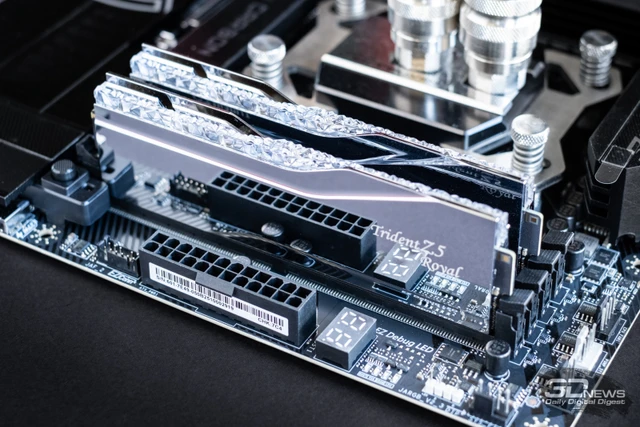
This philosophy is embodied in the G.Skill Trident Z5 Royal DDR5-6400 CL32 kit. Technically, it is a benchmark of modern memory: two 32 GB modules built on binned SK hynix A-die chips. Visually, the Royal series is the pinnacle of extravagance, featuring mirror-finished electroplated heatsinks and massive, crystalline-cut light guides. Despite its flamboyant appearance, the modules maintain a standard height (approximately 44 mm), ensuring compatibility with most dual-tower coolers, though some minor adjustment of fan positions may be required.
A critical nuance lies in its positioning: G.Skill officially targets this kit at Intel systems, which is reflected in the inclusion of an XMP 3.0 profile and the absence of EXPO. However, modern Ryzen motherboards handle XMP profiles with ease. The primary variable here is the "silicon lottery"—the ability of a specific CPU sample to stably maintain a 6400 MHz frequency in synchronous mode (UCLK:MCLK = 1:1). Without manually forcing the controller into synchronous mode, performance may actually drop below that of slower DDR5-6000 memory.
A detailed examination of the PCB reveals a ten-layer structure and a traditional component array: an Ene RGB controller and a Richtek power circuit. But the true value is hidden in the use of 16-gigabit SK hynix A-die chips. In dual-rank modules not intended for frequency records, the manufacturer could have opted for cheaper M-die chips; however, the choice of A-die allows for the most effective minimization of latencies.
Practical benchmarks demonstrate that the dual-rank organization does indeed provide a bandwidth advantage. In Aida64 synthetic tests, the 2×32 GB kit proves to be approximately 6% faster in read and write operations compared to single-rank 2×16 GB modules with similar specifications. This confirms the thesis of more efficient memory bus saturation.
However, the real potential is unlocked through manual tuning. Optimizing timings—reducing tCL from 32 to 30 and tRFC from 943 to 400 cycles—can boost read and write speeds by an additional 12–15% and slash latency by more than 10 ns. That said, the dual-rank structure necessitates the activation of Gear Down Mode (GDM) to alleviate the load on the controller, as well as precise tuning of rank-switching parameters (tRDRDSD and tWRWRSD), which become critical in such modules.
Thermal considerations are also paramount: due to the doubled chip density, dual-rank modules run hotter. In stress tests, temperatures reached 72–73°C. For DDR5, this is a significant figure, yet system stability remained intact even without active airflow.
In real-world scenarios—applications and gaming—the results are more modest. Despite the bandwidth advantage, most tasks on the Ryzen platform are relatively indifferent to this parameter. Performance gains in Adobe Photoshop, Premiere Pro, or modern titles like Cyberpunk 2077 and Space Marine 2 often fall within a marginal 1–2% range. The exception is local LLM inference (e.g., Llama 3.1 8B), where manual timing optimization yields a performance boost of over 14%.
Ultimately, upgrading to a 64 GB dual-rank kit is not a silver bullet for increasing FPS. The primary benefit is the ability to secure a massive memory pool without sacrificing speed. The user gains the headroom necessary for heavy projects and virtual machines while maintaining the performance levels of the best single-rank solutions.
The G.Skill Trident Z5 Royal DDR5-6400 CL32 is a product for those unwilling to compromise between capacity, speed, and aesthetics. While its price point is comparable to a high-end graphics card, it fulfills the need for an uncompromising memory subsystem in flagship Socket AM5 builds, proving that modern dual-rank memory no longer requires a performance sacrifice.
 The Dawn of the 2nm Era in the New iMac