The universe consistently defies human conceptions of scale and the physical limits of matter. The discovery and rigorous analysis of the supergiant galaxy IC 1101 reveal a structure that renders the Milky Way insignificant by comparison. This celestial behemoth serves as a cornerstone for understanding the thresholds of stellar evolution and the dynamics governing the assembly of the cosmos's most massive clusters. By probing its boundaries, we gain a window into the distant future of our own galactic system.
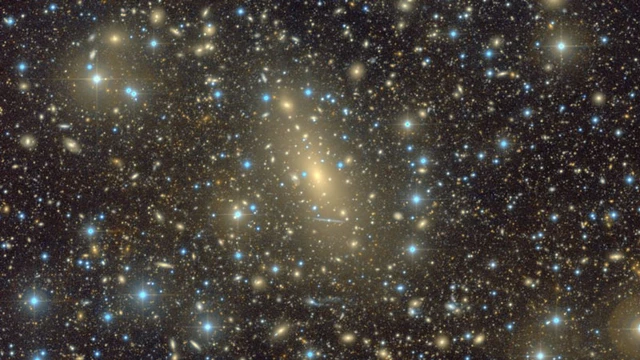
At the heart of the Abell 2029 cluster lies one of the most imposing objects in the known universe: the elliptical galaxy IC 1101. Recent refined astronomical data confirms its status as an absolute titan, with a diameter of approximately 520 kiloparsecs—equivalent to roughly 1.7 million light-years. To put this into perspective, IC 1101 is 17 times larger than the Milky Way in terms of physical scale. Its proportions are so colossal that the galaxy's diameter is comparable to the distance from our own home to the neighboring Andromeda galaxy.
However, defining the true boundaries of such an object is fraught with significant technical challenges. The difficulty lies not in the detection of IC 1101 itself, but in the diffusion of its edges. In supergiant elliptical galaxies, the light from peripheral stars gradually merges with the extremely faint background glow of intergalactic gas and surrounding objects. This is further complicated by the fact that the object is located more than 1 billion light-years away, turning every observation into a battle for every single photon of usable signal.
To overcome these obstacles, researchers leveraged the capabilities of the 2.5-meter Isaac Newton Telescope, situated at the Roque de los Muchachos Observatory in Spain. Utilizing a wide-field camera, scientists captured deep-field images of this sector of the sky. Isolating the galaxy's faint outer glow required meticulous digital processing: astronomers had to strip away the scattered light from over 250 foreground stars and compensate for distortions caused by Earth's atmospheric turbulence.
The analysis of this "cleaned" data led to a fundamental conclusion regarding the nature of IC 1101. This galaxy did not grow through intensive star formation, as is typical for spiral systems. Instead, its size is the result of billions of years of gravitational cannibalism. IC 1101 formed through the sequential absorption of neighboring galaxies, effectively "consuming" the surrounding matter. The scale of this process is staggering: the giant's stellar mass alone is estimated at approximately 3.4 trillion solar masses, dwarfing the mass of the Milky Way.
Even with such incredible parameters, IC 1101 cannot be described as a static or fully formed entity. Observations have revealed faint asymmetric structures surrounding the galaxy, indicating ongoing accretion of matter. It continues to grow, confirming the thesis that the largest structures in the universe continue to evolve even billions of years after their inception.
From a scientific standpoint, IC 1101 represents a "galaxy of the future." It demonstrates the final stage of evolution for systems within massive galactic clusters, where a single surviving object eventually dominates by absorbing all its neighbors. The search for similar giants has become a priority for astronomical teams seeking to determine whether IC 1101 is a unique anomaly or a predictable limit of matter's development in our cosmos.
 The Scale of Starlink's Orbital Dominance