Cybersecurity today resembles an endless arms race, where offensive and defensive tools evolve at a pace that far outstrips the establishment of industry standards. For practitioners of ethical hacking, a seamless environment—one that eliminates friction between the operator and the objective—is paramount. With the launch of Kali Linux 2026.2, Offensive Security once again cements this distribution's position as the definitive benchmark for penetration testing. This latest iteration prioritizes the integration of cutting-edge LLM capabilities and deep system optimization to ensure peak operational efficiency.
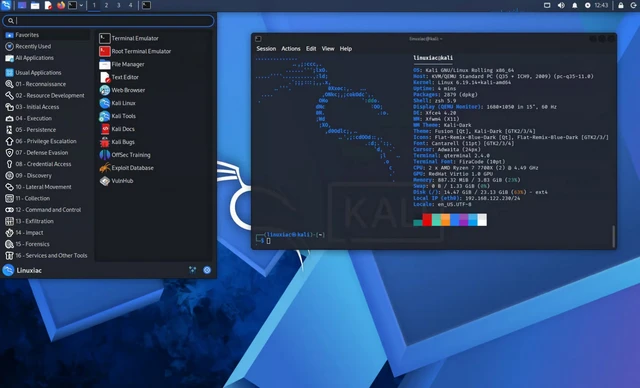
Kali Linux 2026.2 is built upon the battle-tested bedrock of Debian, augmented by the Linux 6.19 kernel. This technological stack strikes a critical balance between system stability and cutting-edge hardware support—a prerequisite for high-stakes operations involving low-level network analysis or exploit development. The visual experience has also received a significant overhaul, introducing modern environments such as GNOME 50 and KDE Plasma 6.6. However, the developers maintain a utilitarian approach: Xfce 4.20 remains the default environment, as its lightweight footprint and predictability are indispensable when operating within resource-constrained virtual machines or Live-boot scenarios.
What truly stands out is the paradigm shift in the toolset. Kali Linux 2026.2 signals a clear trend toward automation and the integration of artificial intelligence. The introduction of shell-gpt marks a new era of terminal interaction, where large language models (LLMs) assist operators in optimizing complex commands on the fly, drastically reducing the time spent scouring documentation for specific syntax. Parallel to this is the implementation of Penelope, an advanced command-line handler designed to make system interaction more intuitive and fluid.
The technical arsenal has been expanded to cover diverse stages of the attack lifecycle. For reconnaissance and OSINT, tookie-osint has been added to streamline social media account discovery, while the uro utility handles URL cleaning to prepare targets for scanning. Credential harvesting has become more versatile with legba, which supports multi-protocol brute-forcing, and hydra-gtk, providing a graphical interface for rapid network password cracking. For those engaged in deep document forensics, oletools is now integrated—an essential utility for analyzing MS OLE2 files and Microsoft Office documents for hidden threats.
The distribution's underlying architecture has also undergone a rigorous revision. The transition of APT source files to the modern DEB822 standard reflects a commitment to modernizing package management, which will enhance system consistency and update velocity over the long term. The integration of Tailscale unlocks new possibilities for establishing secure network overlays, particularly valuable when managing remote penetration testing infrastructures. Furthermore, VM images have been optimized by stripping away redundant graphical software, maximizing available resources for analysis and offensive tasks.
The ecosystem expansion extends to the mobile sector: the Kali NetHunter update broadens the list of supported devices, transforming modern smartphones into fully functional portable security audit stations. For users on version 2026.1, the transition to the new release is seamless, handled via standard repository updates and a full system upgrade.
The distribution remains available in all primary formats—from classic x64 and ARM ISOs to specialized builds for cloud environments, WSL, and virtual platforms. This ensures that Kali Linux 2026.2 remains a universal instrument, adaptable to any infrastructure a security professional may deploy.
 The Price of Acceleration: CXMT’s Rapid Push into Memory