Deep space exploration is as much an exercise in celestial choreography as it is a feat of engineering. Modern interplanetary missions increasingly rely on gravity assists—strategic slingshots that optimize trajectories and maximize resource efficiency. The Psyche probe's recent flyby of Mars stands as a pivotal milestone, seamlessly merging critical system diagnostics with the acquisition of unique visual intelligence. This maneuver not only validates the pinpoint precision of contemporary navigation but also highlights the transformative potential of next-generation optical systems.
Reaching the asteroid belt—and specifically its namesake metallic body—demands an immense expenditure of energy. To minimize fuel consumption and refine its trajectory, the Psyche spacecraft utilized Mars as a gravitational slingshot. This technique, known as a "gravity assist," allows the probe to leverage a planet's gravitational pull to gain velocity and alter its vector of motion—a maneuver critical for ensuring the craft reaches its destination by 2029.
The approach to the Red Planet began on May 2, reaching its zenith on May 15. During this window, the spacecraft effectively transitioned into a full-scale observatory, capturing thousands of high-resolution images of the surface. The culmination of this effort is a captivating timelapse that visualizes the dynamics of the encounter: moving from broad wide-angle shots to a detailed study of the southern pole's ice masses as the probe receded.
Beyond the aesthetic allure of the imagery, the mission served profound engineering objectives. The Martian flyby provided an ideal proving ground for the final calibration of the onboard camera. Engineers focused on verifying sensor sensitivity to diffuse light and ensuring chromatic accuracy within the harsh environment of deep space. Such rigorous testing guarantees that upon arrival at the asteroid, Psyche will be capable of transmitting highly accurate data regarding the object's structure and composition.
Ultimately, this transit validated the full operational capacity of the optical system and the precision of the navigational calculations. The spacecraft now continues its journey toward one of the most enigmatic targets in modern planetary science: a metallic asteroid that may prove to be the exposed core of an ancient protoplanet. Each such milestone brings humanity closer to deciphering the fundamental processes that shaped our Solar System.

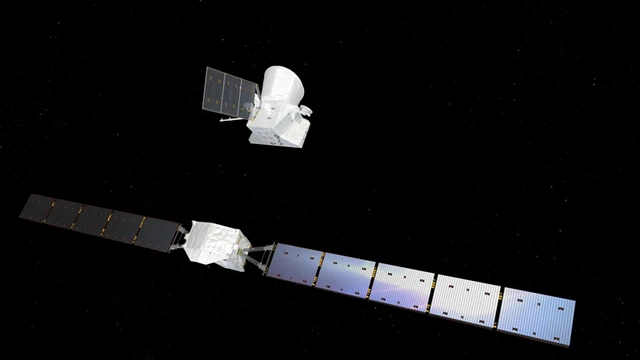 BepiColombo’s Odyssey: At the Threshold of the Sun