The modern gaming industry has fundamentally shifted from simple frame rendering toward intelligent synthesis. At the heart of this evolution lies the pursuit of an optimal equilibrium between raw computational power and visual fidelity. Sony has introduced the updated Enhanced PSSR algorithm, radically redefining the approach to graphics upscaling on the PS5 Pro. This technology marks a pivotal transition from direct color prediction toward more adaptive filtering methods, optimizing neural network performance at the hardware level.
The evolution of upscaling technologies within the PlayStation ecosystem has culminated in Enhanced PSSR—a solution that fundamentally reshapes the logic of GPU resource allocation. The pivotal shift lies in the transition from the Color Predicting Network (CPN) model to the new Kernel Predicting Network (KPN). While the previous iteration utilized only a third of the neural network's parameters when processing 540p low-resolution inputs, KPN has pushed this efficiency to 90%. Consequently, the primary computational load is now concentrated where it is most critical—the reconstruction of detail from low-resolution sources—while the network consumes negligible resources when operating at 4K.
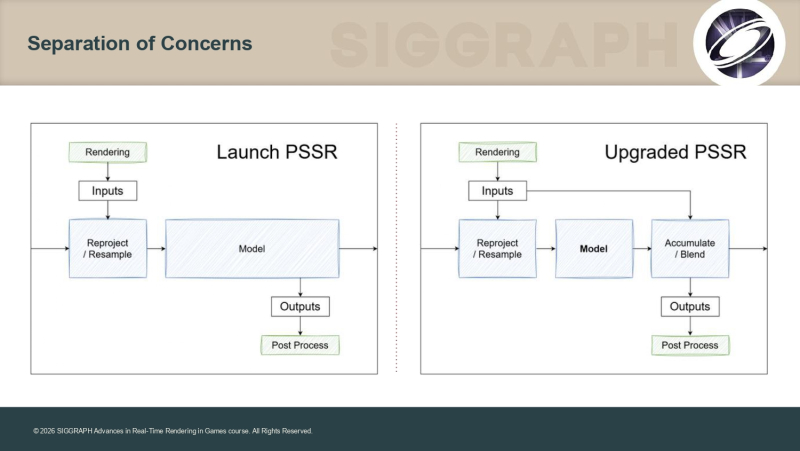
This technological pivot also alters the fundamental principle of image generation. Unlike its predecessor, KPN no longer attempts to predict the final pixel color directly. Instead, the neural network generates mixing weights, leaving the final reconstruction stage to be handled by classical filtering. This approach resolves a critical bottleneck regarding the storage and processing of HDR colors within a limited 8-bit format, significantly reducing the load on compute units and enhancing overall pipeline efficiency.
These optimizations have resulted in a marked improvement in temporal stability and sharper rendering of fine details, all while reducing memory overhead and GPU cycles. While the enhancement is evident across all resolutions, it is most pronounced in scenarios with low source quality. Simultaneously, there has been a quantum leap in the development process: neural network training time has plummeted from four GPU-months to less than a single week, underscoring a profound optimization of the underlying machine learning algorithms.
The implementation of Enhanced PSSR is the culmination of a joint research initiative between Sony and AMD, codenamed Project Amethyst. Deeply tailored to the specific hardware architecture of the PlayStation, this technology now completely supersedes the upscaler version shipped with the PS5 Pro at launch.
Integration of the new version is designed for maximum flexibility. For the majority of existing PS5 Pro titles, the update will be delivered via a system override, improving visual fidelity without requiring developer-issued patches. Meanwhile, studios integrating the latest library directly into their projects will gain full access to the algorithm's capabilities, allowing them to extract the maximum potential from the console's hardware.

 Anthropic’s Strategic Push for Hardware Independence