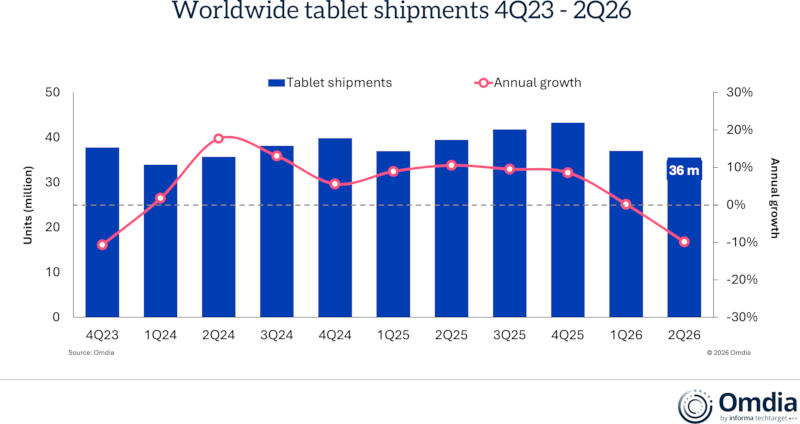
The global tablet market has plummeted in an anomalous downturn that challenges long-standing consumer demand cycles. The traditional second-quarter surge, typically driven by back-to-school procurement, has been replaced this time by a stark regression. This contraction in shipment volumes points to deep structural shifts in user behavior and acute pressures within the supply chain. These current dynamics expose the vulnerability of even the industry's most formidable players in the face of systemic market stagnation.
Latest quarterly statistics paint a sobering picture for the mobile computing landscape. According to analytics from Omdia, global tablet shipments have contracted by nearly 10%, falling to 35.5 million units. This decline is particularly striking given historical trends: the second quarter has traditionally been a period of growth, driven by seasonal refreshes in the education sector and private consumer upgrades.
Apple’s leadership remains undisputed, though the company has not been immune to these broader market headwinds. A 5% dip in iPad revenue and a decline in shipments to 13.5 million units underscore a general trend toward market saturation. Nevertheless, Apple still commands nearly 38% of total global volume, reaffirming deep brand loyalty and the iPad's status as the benchmark device in its class.
Beneath these aggregate figures, however, lies a stark divergence between industry players. While Samsung and Huawei have seen notable declines, Lenovo stands as the sole member of the top five to post growth. Lenovo's 27.1% increase in shipments suggests an ability to effectively navigate the mid-range segment or successfully scale its enterprise solutions. Currently, the market hierarchy is defined by Apple’s overwhelming dominance, followed by Samsung (16.3%), Lenovo (11.1%), Xiaomi (8%), and Huawei (7.7%).
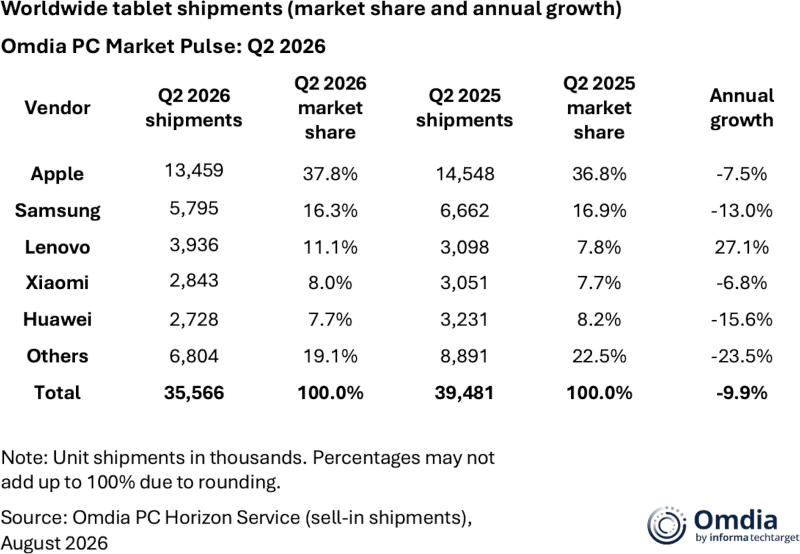
The most severe impact has been felt by secondary manufacturers. The combined share of vendors outside the top five plummeted by 23.5%, signaling a rapid market consolidation around a few dominant giants. Smaller players are simply unable to remain competitive amidst falling demand and constrained resources.
Compounding these challenges is the global component crunch. Faced with semiconductor shortages, manufacturers are being forced to pivot their priorities, shifting focus away from mass-market budget models toward high-margin premium segments. This shift is effectively erasing affordable devices from the catalog, rendering the market increasingly elitist.
Paradoxically, tablets continue to integrate more deeply into daily life, effectively supplanting traditional PCs in numerous use cases. The rise of large-screen models and their adaptation for commercial workflows have made these devices indispensable tools. Yet, the current crisis demonstrates that even the status of being a "household essential" cannot shield the industry from macroeconomic volatility and systemic logistical failures.

 The Price of Acceleration: CXMT’s Rapid Push into Memory