Today's imaging market is polarized, caught between the drive for extreme portability and the uncompromising performance of interchangeable lens systems. Amidst this dichotomy, the superzoom category has long lingered in the periphery, awaiting a technological breakthrough significant enough to justify its inherent bulk. Sony’s return to the RX10 lineage represents a strategic effort to redefine the "all-in-one" tool for the discerning enthusiast. The new RX10 V aims to synthesize the prowess of contemporary sensor technology with a legendary focal range.
Nine years after the previous generation, Sony returns to the fray with one of its most ambitious formats: the premium superzoom. The RX10 V is more than a mere refresh; it is a concerted effort to migrate the breakthroughs of flagship mirrorless systems into a fixed-lens chassis. This device is engineered for those who demand mobility without compromising the ability to capture wildlife or high-speed sports, liberating the photographer from the burden of a heavy lens kit.
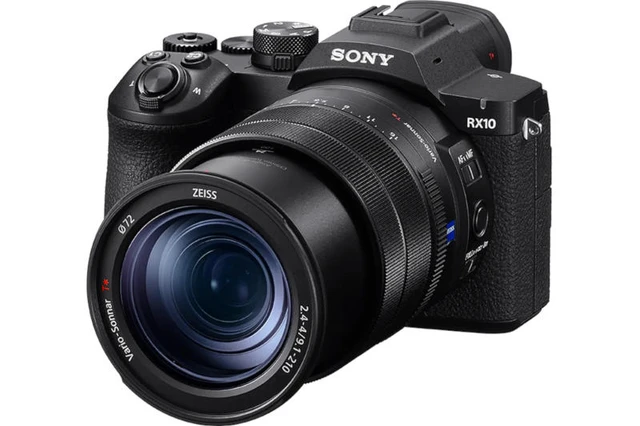
The camera's optical bedrock remains unchanged—a move reflecting the manufacturer's calculated pragmatism. The Zeiss Vario-Sonnar lens, featuring an equivalent focal range of 24 to 600mm and an aperture of f/2.4-4, delivers an impressive 25x zoom. Such versatility allows for an instantaneous transition from wide-angle vistas to extreme telephoto reach, a critical advantage in environments where swapping lenses is either physically impossible or impractical.
However, the true transformation has occurred under the hood. At the heart of the RX10 V now beats a new 20.1-megapixel stacked sensor. This memory-stacking architecture radically accelerates data readout, enabling continuous shooting speeds of up to 30 frames per second. A pivotal advantage here is the blackout-free viewfinder, allowing the photographer to remain visually locked onto the subject during the most critical moments.
The camera's computational layer has been entirely overhauled. A new processor powered by AI algorithms elevates the autofocus system to the level of the professional Alpha series. Subject tracking is now more precise and predictable, with real-time recognition for humans and animals. Particularly noteworthy is the "Speed Boost" function, inherited from the professional A9 III flagship, which further pushes the boundaries of burst shooting speeds.
Ergonomics and power management have also seen significant upgrades. The exterior has been redesigned to align with the aesthetic of modern mirrorless cameras. One of the most tangible improvements is the transition to the NP-FZ100 battery. Utilized across most current A-series models, this battery increases the device's stamina by 50% over its predecessor—a vital upgrade for extended field excursions.
The video capabilities of the RX10 V transform it into a comprehensive tool for content creators. The camera supports 4K recording at 60 fps, while a 120 fps mode with a sensor crop is available for cinematic slow-motion. A professional pedigree is evident in the inclusion of S-Log3 and S-Cinetone color profiles, providing wide dynamic range and cinematic color reproduction for post-production grading. Additionally, the camera supports 4K live streaming via USB Type-C with simultaneous recording to the memory card.
Nevertheless, evolution has come with certain trade-offs. In the pursuit of processing power and battery capacity, engineers have omitted the built-in neutral density (ND) filter and the pop-up flash found in the previous model. For many professionals, the absence of an integrated ND filter will be a noticeable drawback when shooting with a wide-open aperture in bright sunlight.
Sony's pricing strategy reflects current market realities. The device is positioned at $2,299.99. When compared to the RX10 IV's 2017 launch price of $1,700, this jump appears justified given global inflation and the integration of costly AI technologies. It is a tool for the discerning enthusiast seeking the sweet spot between professional image quality and the absolute convenience of a single, all-in-one lens.
 Nvidia’s Technological Pragmatism in the Open-Model Race