The vision of a comprehensive domestic butler—one capable of absorbing the drudgery of daily chores—is steadily migrating from the realm of science fiction into the domain of applied engineering. Modern robotics is undergoing a paradigm shift, pivoting away from rigid, specialized industrial systems toward adaptive devices engineered to navigate the inherent unpredictability of residential environments. Weave Robotics is making a significant stride in this direction with the introduction of Isaac 1, a mobile platform dedicated to domestic maintenance. Designed to automate the most tedious aspects of housekeeping, the robot aims to transform daily chaos into a meticulously structured environment.
The road to a universal home assistant is seldom a straight line. For Weave Robotics, the development of Isaac 1 represents the natural progression of its predecessor—the Isaac 0, a stationary model hyper-specialized for a single, labor-intensive task: folding laundry. The transition from a fixed installation to a mobile platform marks a fundamental paradigm shift; the robot no longer waits for the work to be brought to it, but instead navigates to the space where the work exists.
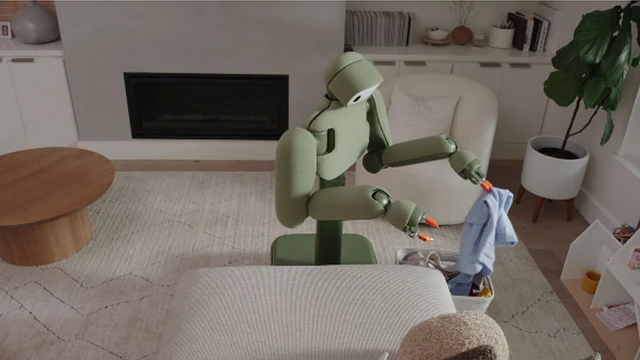
Isaac 1’s operational framework is divided into two primary scenarios designed to address the core needs of domestic upkeep. The first, Laundry Flow, encompasses the entire textile lifecycle: from locating and gathering scattered dirty clothes to transporting hampers and executing the final, precise fold. The second scenario, Daily Reset, is built around the concept of "returning a room to its baseline state." In this mode, the robot tackles what is often termed "invisible labor"—making beds, adjusting pillows and blankets, and picking up stray toys and shoes. Essentially, the device acts as a custodian of basic visual order.
The technical execution of Isaac 1 reflects a pragmatic approach to ergonomics. Rather than pursuing the complexity and energy inefficiency of bipedal locomotion, the engineers opted for a wheeled base, significantly enhancing platform stability while reducing overall cost. The base, measuring 52 × 56 cm, serves as the foundation for a telescopic chassis with a height range of 91 to 175 cm. This architecture allows the device to adapt to various surface levels, providing a maximum reach of up to 203 cm.
Particular attention has been paid to kinematics. The robot boasts a total of 21 degrees of freedom (DoF): six for each of the two arms, two for the torso and base, two for the neck, and one for each gripper. While this configuration provides the necessary flexibility to manipulate complex objects, the developers candidly admit that the device does not yet possess exceptional dexterity.
To ensure seamless integration into the home interior, the team employed a strategy of "aesthetic softening." Isaac 1 is encased in interchangeable fabric covers. This design choice serves a dual purpose: first, it minimizes the risk of furniture damage or human injury during accidental contact; second, it visually distances the machine from the cold, sterile image of an industrial manipulator, making it feel more welcoming in a residential environment.
In terms of autonomy, Isaac 1 can operate for up to eight hours on a single charge, with a recovery time of just two hours. Control is managed via Wi-Fi, and for situations where autonomous algorithms reach a stalemate due to environmental complexity, a teleoperation mode is available. This serves as a critical safeguard, allowing a human operator to remotely correct the robot's actions in non-standard scenarios.
The product's economic model offers two ownership paths: a direct purchase for $8,000 or a subscription model at $449 per month with an initial $250 deposit. This approach lowers the barrier to entry for high-end technology by shifting capital expenditures (CapEx) into operational expenses (OpEx).
While initial shipments are expected this autumn, a full-scale mass-market rollout is slated for 2027. This buffer period is essential for refining object-interaction algorithms and optimizing navigation. It is fitting that the device is named after Isaac Asimov—the man who laid the ethical and conceptual bedrock of modern robotics. Today, Asimov's visions are taking physical form in a wheeled assistant that may not be writing the laws of robotics, but certainly knows how to make a perfect bed.
 The Phenomenon of the Foldable iPhone Ultra