The line between a simple text-based chatbot and a comprehensive productivity tool is effectively vanishing. OpenAI is shifting its paradigm from providing mere answers to deploying autonomous agents capable of orchestrating complex business processes independently. The rollout of ChatGPT Work and the GPT-5.6 model signals a strategic pivot: AI is evolving from a consultant into an executor, taking ownership of intricate, multi-stage workflows. This represents a decisive move toward the democratization of automation, placing powerful development capabilities directly into the hands of every knowledge worker.
The current evolution of Large Language Models (LLMs) is defined by a fundamental shift: moving beyond mere content generation toward the execution of complex actions. OpenAI has capitalized on this trajectory with the introduction of ChatGPT Work, a specialized mode that effectively transforms the AI into a personal agent tailored for professional productivity. At its core lies Codex—a technology long regarded as a niche tool for developers. However, usage metrics revealed a surprising pivot: of Codex's five million weekly users, over a million were leveraging it for non-coding tasks. This organic market demand paved the way for Work, a product that translates the power of automation into an intuitive interface accessible to a broad spectrum of users.
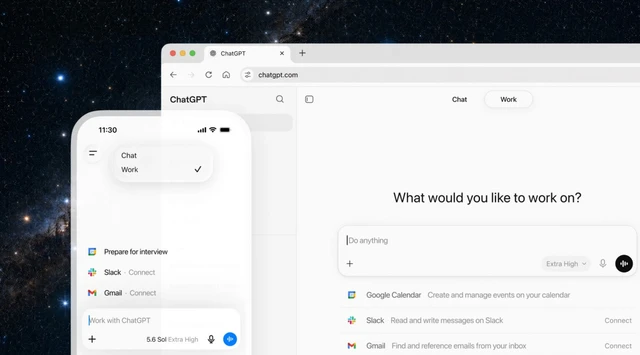
ChatGPT Work is designed to shoulder the burden of corporate drudgery. The agent can aggregate data from disparate applications and files, synthesizing them into structured tables, presentations, documents, and even fully functional web applications. External integration is handled via a robust plugin system, allowing the agent to connect seamlessly with Slack, Microsoft Teams, Google Drive, SharePoint, corporate email services, calendars, and CRM systems. Invoking a specific service is as simple as using the "@" symbol within a prompt, making interaction with the tool ecosystem entirely intuitive.
Perhaps the most compelling feature is the agent's capacity for autonomous planning. Rather than attempting to solve a complex project with a single response, Work decomposes the objective into a sequence of actionable steps, executing them independently. This process may span several hours, during which the user acts as a supervisor—monitoring progress, refining the trajectory, and authorizing critical actions. Efficiency is further amplified by the Scheduled Tasks feature, which enables the automation of recurring actions based on a schedule or specific trigger. For instance, the AI can analyze Slack threads weekly to update upcoming meeting agendas, operating entirely in the background.
Alongside these agentic capabilities, OpenAI has unveiled Sites, currently in public beta. This tool allows users to transform raw ideas or accumulated data into interactive websites and web applications accessible via a simple link. The scope ranges from live dashboards and project trackers to internal corporate portals. A key differentiator is its dynamic synchronization: when source data changes, the agent automatically updates the site's content, effectively positioning ChatGPT as a high-velocity, no-code prototyping platform.
This strategic reorganization extends to the desktop product line. Codex has ceased to exist as a standalone application, becoming integrated into the revamped ChatGPT desktop client. The interface is now bifurcated into three functional modes: Chat, Work, and Codex. The desktop version boasts expanded privileges, including access to local files, an integrated browser, and most significantly, the Computer Use feature. This allows the AI to operate the computer on the user's behalf, simulating human interactions within the operating system. As part of this optimization, the Atlas AI browser project was shuttered, as the company shifted its focus toward a Chrome extension that integrates ChatGPT's capabilities directly into the browser's side panel.
Access to these new capabilities is tiered by subscription plan. In the web and mobile versions, the Work mode will initially be rolled out to Pro, Enterprise, and Edu users, followed by Plus and Business tiers. However, in the new desktop application, access to Chat, Work, and Codex is open to all users globally, including those on the free tier. For the latter, operations are powered by the GPT-5.6 Terra model, ensuring that cutting-edge agentic technology is accessible to the widest possible audience.
 iPhone 17: Dominating the Global Market