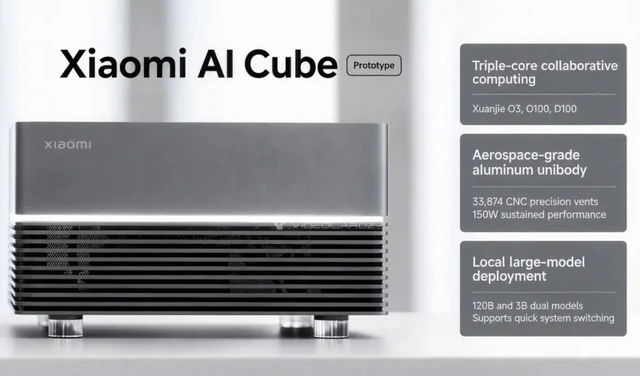
The global trend toward the decentralization of artificial intelligence is shifting the computational center of gravity away from cloud services and directly onto the user's desktop. The industry is increasingly focused on creating autonomous nodes capable of processing massive volumes of data, eliminating network latency and the precarious dependence on external servers. Xiaomi's AI Cube prototype embodies this paradigm, synthesizing the latest advancements in semiconductor engineering. This device is not merely a compact computer; it is a bold engineering manifesto on the integration of specialized deep-learning silicon.
The AI Cube's aesthetic is a testament to an uncompromising approach to thermal management—the primary hurdle in engineering high-performance compact systems. The chassis is crafted from a single block of precision CNC-machined aluminum. Its surface is perforated with 33,874 precision-cut holes, effectively transforming the entire enclosure into a massive heatsink capable of dissipating heat efficiently at a nominal system power draw of 150W.
At the heart of the system lies a sophisticated multi-chip architecture, where each component is dedicated to a specific computational segment. The primary compute node is the Xring O3 mobile platform, which integrates a 10-core CPU and a 16-core G2-Ultra NX GPU, augmented by a neural processing unit (NPU) delivering 200 TOPS. Notably, the Xring O3 is the first mobile processor to implement support for the LPDDR6 memory standard, significantly expanding data throughput and reducing power consumption during transmission.
For heavy-duty machine learning workloads, the system leverages the specialized Xring O100 accelerator. Here, Xiaomi has employed cutting-edge semiconductor packaging: a 6nm logic layer is integrated with the NPU via Wafer-on-Wafer (WoW) technology. The vertical stacking of two high-speed DRAM layers, combined with Hybrid Bonding, has reduced the interconnect pitch to 1.4 $\mu$m. This Face-to-Face metallic bonding minimizes the distance between the compute layer and memory, achieving an impressive bandwidth of 1.22 TB/s.
Orchestration and intelligent process management are handled by the Xring D100—the system's most advanced component, fabricated on a 3nm process node. This chip combines a 20-core CPU and a 16-core NPU, supporting up to 160 GB of unified memory. Such a configuration enables the deployment of local large language models (LLMs) with up to 200 billion parameters, effectively transforming this mini-PC into a fully autonomous workstation for LLM operations. During demonstrations, the device successfully handled models ranging from 3 to 120 billion parameters.
Despite these formidable specifications, the AI Cube remains a prototype. The commercial release of its core components—the O100 accelerator and the D100 controller—is slated for 2027. This roadmap signals the company's long-term strategy to build a proprietary silicon ecosystem capable of competing with industry leaders in the high-performance edge computing segment.
 The Evolution of the Apple Home Ecosystem