The convergence of biological organisms and microelectronics is ushering in a new era of autonomous agents engineered for extreme environments. Where traditional robotics often hits a wall regarding miniaturization and energy efficiency, nature provided the solutions millions of years ago. Today's advancements in insect cyborgs are transforming living organisms into precision-guided reconnaissance tools. Coupled with specialized life-support systems, these bio-hybrid agents can operate where conventional drones are powerless—from submerged ruins to the desolate surfaces of other planets.
The drive toward insect-based robotics is rooted in pure pragmatism: a living organism already possesses an optimized power source, an efficient locomotion system, and hardwired obstacle-avoidance reflexes. Engineers at Nanyang Technological University in Singapore have successfully realized the concept of remote-controlling Madagascar hissing cockroaches by implanting electrodes directly into their sensory organs—the cerci. This technology enables more than just the manipulation of a single specimen; it allows for the coordination of an entire swarm, transforming a group of insects into a single, distributed mechanism.
The primary objective of such developments is the creation of search-and-rescue systems capable of operating within disaster zones. Bio-robots equipped with infrared sensors can penetrate narrow debris and locate survivors where heavy machinery would be useless. However, a significant limitation remained: the inability to operate in flooded environments. This necessitated a fundamentally new solution—a miniaturized diving apparatus.
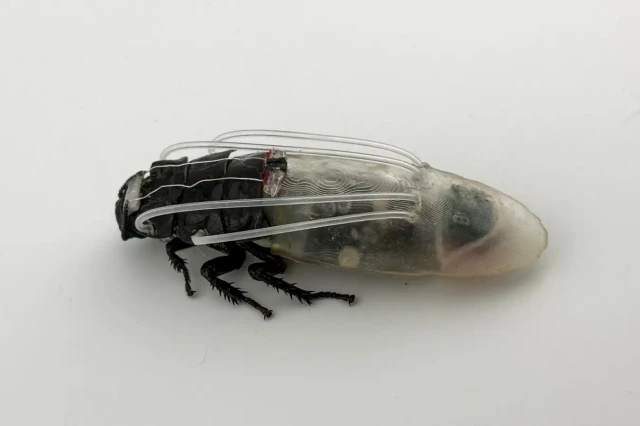
The technical implementation of this "suit" required a nuanced grasp of entomological physiology. Cockroaches breathe through specialized pores called spiracles, located on the abdomen and thorax. To prevent water from infiltrating the respiratory system, researchers utilized 3D printing with polymer resin to create a waterproof chassis covering the abdominal section. To facilitate gas exchange, microscopic tubes were integrated leading to the thoracic spiracles; this configuration ensured that limb mobility remained intact and the insect's movement was not hindered.
The method of oxygen delivery is particularly noteworthy. Rather than utilizing cumbersome pressurized gas canisters, the team employed a chemical reaction: a mixture of hydrogen peroxide and manganese dioxide. The interaction between these substances releases pure oxygen, which the insect consumes in real time.
Test results confirmed the high efficiency of this approach. These cyborgs are capable of functioning underwater at depths of up to 50 centimeters for three hours without any adverse health effects. Notably, the hydrodynamic drag of the suit proved minimal: while land speed was recorded at 87.5 mm/s, it dropped only to 78.4 mm/s in an aquatic environment, demonstrating the system's high level of adaptability.
The potential applications for such technology extend far beyond terrestrial disasters. Researchers are exploring the use of bio-robots in deep space—an environment that, like water, is characterized by a lack of free oxygen. Immediate plans include testing the suits under vacuum conditions, extreme temperature fluctuations, and intense radiation exposure to simulate the surface of Mars or orbital stations.
Nevertheless, the expansion of bio-robotics into space faces a formidable ethical and scientific barrier: the issue of planetary protection. Space agencies strictly limit the risk of biological contamination of other planets by Earth-borne microorganisms. Consequently, even if the technical capability to deploy cyborgs to Mars is realized, the sterilization of these "emissaries" will become the primary challenge for future missions.
 The Phenomenon of the Supermassive Galaxy IC 1101