The transition from mere algorithmic execution to authentic scientific reasoning has emerged as the primary frontier for contemporary Large Language Models (LLMs). The capacity to discern a genuine biological signal from stochastic noise—and to autonomously pivot a research trajectory based on those findings—is precisely what distinguishes a sophisticated tool from a true digital scientist. OpenAI’s latest benchmark, GeneBench-Pro, is designed to quantify this very "research intuition." While the results showcase impressive strides in AI's cognitive capabilities, they simultaneously expose a fundamental chasm between observation and inference.
The current evolution of artificial intelligence is marked by a strategic pivot: moving away from mere content generation toward the resolution of complex analytical challenges. In the realm of biomedicine, this represents a transition from executing pre-defined pipelines to the ability of a model to independently formulate hypotheses and critically evaluate data. GeneBench-Pro was engineered specifically to stress-test this competency. It evaluates whether an AI can discern if a detected pattern reflects genuine biological reality or is simply a technical artifact, and whether the system recognizes when a result is sufficiently robust to warrant a final conclusion.
The benchmark framework consists of an array of 129 synthetic tasks spanning ten fundamental domains and 21 sub-disciplines—ranging from population genetics to oncogenomics and pharmacogenomics. The use of synthetic data allows OpenAI to maintain total control over causal relationships, ensuring deterministic verification of answers. To ensure the realism of these scenarios, external experts—including professors and postdoctoral researchers—were brought in to verify that the target solutions aligned with rigorous academic standards.
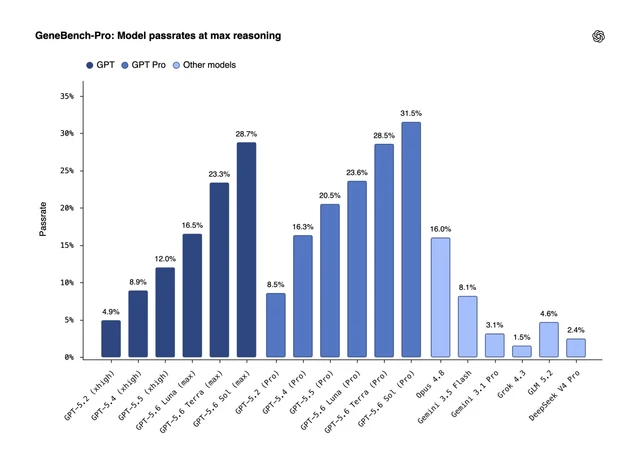
The trajectory of model performance in this test has been rapid. While the first iteration of GeneBench proved nearly insurmountable for GPT-5 (with success rates below 5%), the current GPT-5.6 Sol model has made a significant leap, surpassing the 28.7% threshold at maximum reasoning levels and reaching 31.5% in Pro mode. This progress is evident not only in the metrics but in a qualitative shift in problem-solving methodology.
A prime example is found in pharmacogenomics. Where previous iterations were limited to constructing standard Cox models—ignoring the feedback loops between therapy and confounding factors—GPT-5.6 Sol independently pivoted to using marginal structural models with inverse probability weighting. Furthermore, the model demonstrated genuine critical thinking by correctly excluding patients who had begun treatment prior to the observation period, adhering to the gold standards of rigorous scientific analysis.
Against this leader, competitors show a marked lag: Claude Opus 4.8 scores 16%, Gemini 3.5 Flash reaches 8.1%, while DeepSeek V4 Pro and Grok 4.3 remain in the single digits. However, even for the top-performing model, the success rate remains below one-third of all tasks, suggesting the existence of a systemic cognitive barrier.
Error analysis reveals a specific disconnect between problem identification and decision-making. The model frequently flags a warning signal—such as a data quality control failure or a technical artifact—yet fails to integrate this observation into its overall strategy. The AI continues to follow its initial plan despite the contradictions it has uncovered. In an academic setting, this behavior is characteristic of a junior researcher: they are capable of collecting observations but lack the ability to pivot their approach "on the fly," unlike a seasoned scientist who reconstructs the entire methodology upon discovering a systemic error in the data.
The complexity of these tasks is corroborated by the academic community. Experts from UCLA note that such cases would be challenging even for a PhD student working without supervisory guidance. The primary difficulty lies precisely in the presence of "noisy" data and technical imperfections, which demand deep analytical synthesis rather than the simple application of standard methods to a sterile dataset.
Despite its success, there is a risk of inherent benchmark bias: GPT models were utilized to refine the tasks during their creation, potentially tailoring the test to OpenAI's strengths. Nevertheless, the substantial performance gap between GPT and other developers suggests that this is not merely a case of "overfitting," but rather a genuine qualitative leap in the capacity of neural networks for complex scientific reasoning.
 Anthropic’s Strategic Push for Hardware Independence