Modern astronautics is undergoing a fundamental paradigm shift, transitioning from sporadic government-led expeditions toward the systematic industrialization of Earth's orbit. SpaceX has emerged as the primary catalyst for this transformation, effectively reducing rocket launches to routine logistical operations. The recent deployment of the O3b mPOWER telecommunications satellites represents more than just another commercial win; it stands as a symbolic milestone. With 700 flights completed by the Falcon family, the absolute dominance of reusable systems in contemporary space transportation is now indisputable.
The latest milestone in the evolution of global satellite communications has been marked by the successful deployment of three O3b mPOWER satellites into Medium Earth Orbit (MEO). Each of these spacecraft, weighing approximately 1,700 kg, is designed to expand the constellation of the Luxembourg-based operator SES. The primary technical objective was to establish a network characterized by predictably low latency and high throughput—capabilities that are mission-critical for industries where seamless connectivity is a matter of operational efficiency and safety.
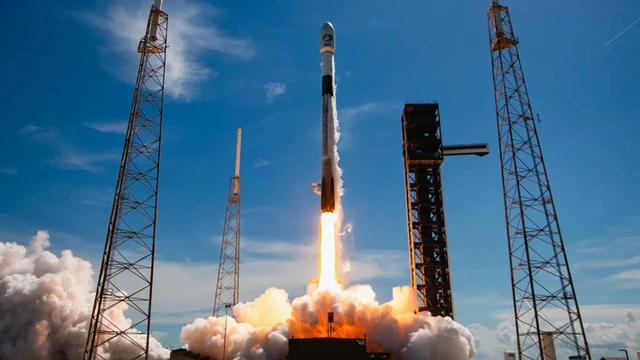
The mission was executed by a Falcon 9 rocket launching from the U.S. Space Force's Cape Canaveral Space Force Station. The process of delivering the payload to an altitude of 8,000 km took approximately 33.5 minutes, with the final satellite positioning phase lasting 14 minutes. This mission serves as the final chord in the assembly of the mPOWER constellation, a deployment effort that began in December 2022.
The technical execution of the booster's recovery warrants particular attention. Nine minutes after liftoff, the first stage (serial number B1080) performed a precision landing on the autonomous drone ship A Shortfall of Gravitas in the Atlantic Ocean. This marked the 29th flight for this specific booster, demonstrating the extraordinary lifespan and reliability of SpaceX's reusable components.
This launch also served as a landmark anniversary, marking the 700th flight of the Falcon family. The lineage began in March 2006 with the debut of the Falcon 1. The early stages were fraught with difficulty—five launches, only two of which were successful—yet these efforts laid the essential foundation for the Falcon 9. The latter has become the industry's true "workhorse," handling the vast majority of the series' missions. Complementing it is the Falcon Heavy, which has completed 13 launches to date, providing the capacity for super-heavy payloads.
The sheer scale of SpaceX's current operational cadence is staggering: in this year alone, the company has executed 107 orbital launches. The overwhelming majority—105—were handled by the Falcon 9, with two attributed to the Falcon Heavy. Parallel to this, a generational shift is underway. In 2026, the company conducted two suborbital tests of the Starship mega-rocket and is currently preparing for a third test, which could mark the system's first full orbital flight, fundamentally redefining the cost and accessibility of outer space.
 The Evolution of Battery Endurance in the Honor Magic9 Series