The LLM arms race is shifting from a showcase of raw computational power toward a new era of optimization and industrial-scale deployment. The launch of OpenAI’s GPT-5.6 family signals a strategic pivot: success is no longer measured by benchmark records, but by the "cost per unit of intelligence." By implementing a tiered access model, OpenAI is bringing sophisticated reasoning capabilities to even its free-tier users, effectively evolving AI from an elite tool into a ubiquitous infrastructural utility.
The rollout of the GPT-5.6 family represents more than a mere version update; it is the deployment of a comprehensive ecosystem stratified by performance and cost. The hierarchy of these new models is clearly defined by three distinct roles: the flagship Sol, the balanced Terra, and the lightweight Luna. Notably, OpenAI is pivoting toward mass accessibility for the first time: users on free tiers now have access to Terra, whose capabilities are comparable to the previous flagship, GPT-5.5. The more potent iterations—Sol and Sol Pro—remain the exclusive domain of paid subscribers and enterprise clients.
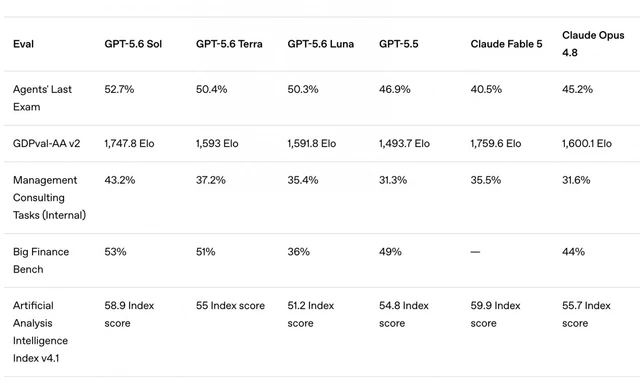
The primary strategic focus of this iteration is efficiency. Data from Artificial Analysis indicates that while Sol possesses a reasoning capacity on par with Claude Fable 5, it operates 61% faster and costs approximately half as much. In complex agentic workflows requiring long-term planning across various professional domains, Sol demonstrates a clear advantage over its competitor. Sam Altman emphasized that in agentic coding scenarios, the new model has become 54% more efficient in terms of token consumption. Consequently, OpenAI is shifting the narrative from "who is more intelligent" to "who solves business problems more efficiently."
The GPT-5.6 technological stack has expanded through the introduction of new model "effort" levels. While the max mode grants Sol more time for internal deliberation, the ultra mode elevates the process to the level of multi-agent orchestration. In this mode, the system by default coordinates four parallel agents, sacrificing speed and token volume to achieve uncompromising quality in the most daunting tasks. For developers, the introduction of Programmatic Tool Calling is a critical milestone. The model no longer simply invokes tools; it writes and executes small programs that independently manage external services and filter data, eliminating the need to route every intermediate step through the primary context window.
However, this technological dominance is not absolute. In "raw intelligence" benchmarks, such as SWE-Bench Pro and FrontierMath, Anthropic's Claude family continues to hold the lead. Specifically, Claude Mythos 5 and Fable 5 deliver significantly higher results in complex mathematics and deep programming. A comparison has already taken hold within the industry: if GPT-5.6 is akin to a perfectly tuned Porsche—reliable, fast, and predictable in daily operation—then Anthropic's developments are like a warp drive, indispensable when one needs to leap into uncharted territories of knowledge.
The most intriguing aspect of the release is the disclosure of the internal RSI (Recursive Self-Improvement) index. For the first time, OpenAI has demonstrated how AI is accelerating the creation of its own subsequent versions. The RSI index tracks model efficiency in real-world researcher tasks: from optimizing compute kernels and training recipes to debugging ML experiment code. Sol showed a significant increase in efficiency compared to GPT-5.5, a trend mirrored in the company's internal traffic: the volume of compute dedicated to internal coding inference has surged 100-fold in six months. This is a direct path toward a recursive self-improvement scenario, where the model becomes the primary tool for designing its own successor.
The launch of GPT-5.6 also reflects the growing influence of regulatory oversight. The model underwent a pre-screening process by the U.S. government, establishing a new standard for the market's largest players. Parallel to this, OpenAI has substantially tightened its safety protocols. Sol's new cyber-filters block ten times more hazardous content, and access to the most powerful capabilities now requires mandatory identity verification. Thus, the democratization of intelligence is being accompanied by a tightening of control and increased transparency in system utilization.
 iPhone 17: Dominating the Global Market