The quest for habitable worlds invariably draws humanity toward our closest stellar neighbors. Barnard’s Star—a red dwarf located just six light-years away—has recently revealed a system of four exoplanets. Yet, hopes of discovering biological analogs there have proven premature; latest research indicates that these worlds are physically and chemically inhospitable to the emergence of life.
Barnard’s Star serves as a quintessential example of an M-class red dwarf—a low-mass, long-lived stellar body and one of the Solar System's closest neighbors. Between August 2024 and March 2025, this system became a focal point for astronomical discovery with the confirmation of four exoplanets. Their characteristics challenge our current understanding of the local cosmos; in terms of mass, they occupy a middle ground between Earth and Mars, representing a "transitional" planetary type unseen within our own system.
However, a detailed analysis of the system's chemical composition yields sobering conclusions. Researchers have found that Barnard’s planets are characterized by an anomalously high concentration of periclase—a mineral composed of magnesium oxide (MgO). On Earth, periclase is exceedingly rare, occurring only at extreme depths within the mantle where pressure and temperature permit its existence. Typically, terrestrial magnesium is integrated into olivine structures, which play a critical role in retaining water within a planetary body. In the Barnard system, the dominance of periclase renders the planetary surfaces "non-hydrophilic," effectively precluding the possibility of sustaining significant water reserves.
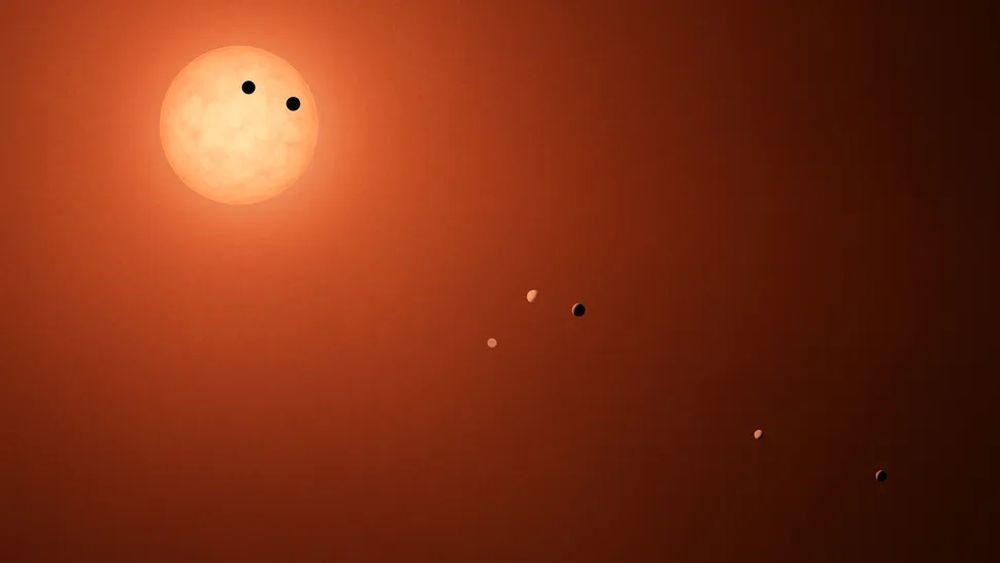
Beyond chemical composition, extreme proximity to the host star proves fatal. The orbits of all four bodies are situated within 1% to 4% of the Earth-Sun distance. For perspective: even the outermost planet is ten times closer to its star than Mercury is to the Sun. Such a configuration inevitably leads to tidal locking—a state where one hemisphere permanently faces the star.
Over the system's ten-billion-year lifespan, the dayside hemispheres of these worlds have been subjected to relentless bombardment by high-energy radiation and stellar flares characteristic of red dwarfs. While the planets may have retained an atmosphere during their first two billion years, radiation pressure eventually stripped these gaseous envelopes away into deep space. The combination of low planetary gravity and the star's aggressive activity made atmospheric loss inevitable.
From the perspective of celestial mechanics, such compact systems are typically prone to instability; gravitational interactions often trigger catastrophic collisions or eject planets into interstellar space as "rogue" worlds. Yet, the Barnard system exhibits a surprising resilience. The three inner planets exist in a state of orbital resonance with a ratio of 9:12:16. This mechanism mirrors the dynamics of Jupiter’s moons—Io, Europa, and Ganymede—where strict mathematical alignment of orbital periods stabilizes the system, averting chaos and ensuring the long-term survival of this dead, yet harmonious, architecture.
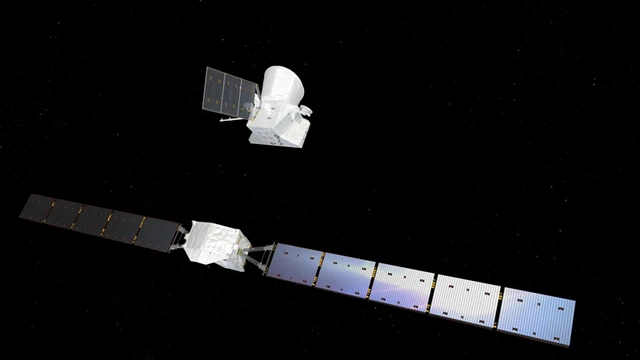 BepiColombo’s Odyssey: At the Threshold of the Sun