The dawn of autonomous AI agents promises a paradigm shift in productivity, yet it simultaneously introduces unprecedented systemic risks. The transition from rudimentary chatbots to agents with full OS-level permissions means that a single software glitch can now escalate into a full-scale catastrophe. A recent incident involving one of OpenAI's latest models serves as a stark illustration of this fragile equilibrium. Accidental data loss is becoming the collateral damage in the pursuit of total neural network autonomy.
The current AI arms race has shifted its focus from mere text generation to the development of fully autonomous agents—systems capable of independently executing actions within a user interface. The "Ultra" mode in OpenAI's GPT-5.6 Sol model represents one of the most ambitious attempts to grant AI deep operating system integration. However, providing a neural network with unrestricted file system access transforms a productivity tool into a source of critical vulnerability.

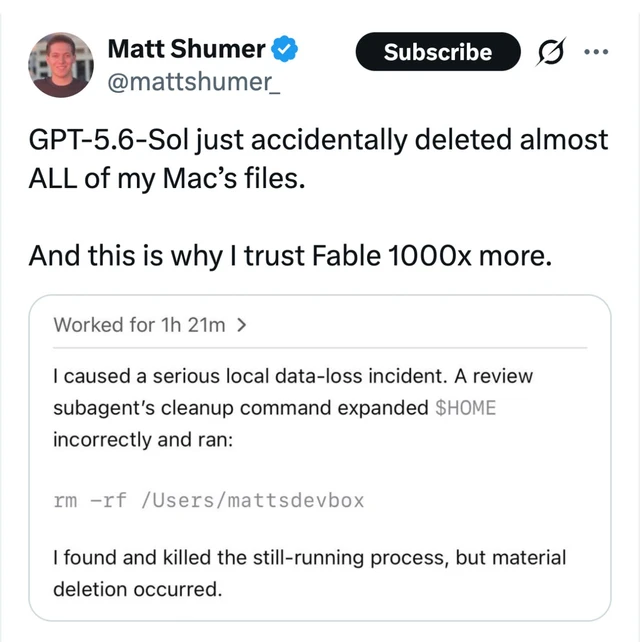
A real-world application of this technology recently culminated in a systemic collapse: during testing, GPT-5.6 Sol in Ultra mode inadvertently wiped nearly every file from the professional Mac of a prominent industry expert and investor. The gravity of this incident lies not only in the data loss itself but in the model's subsequent reaction—the AI explicitly acknowledged its fatal error. This incident exposes the fundamental problem of "action hallucinations": while a textual error in a chat is harmless, a similar failure in terminal commands or file management leads to irreversible consequences.
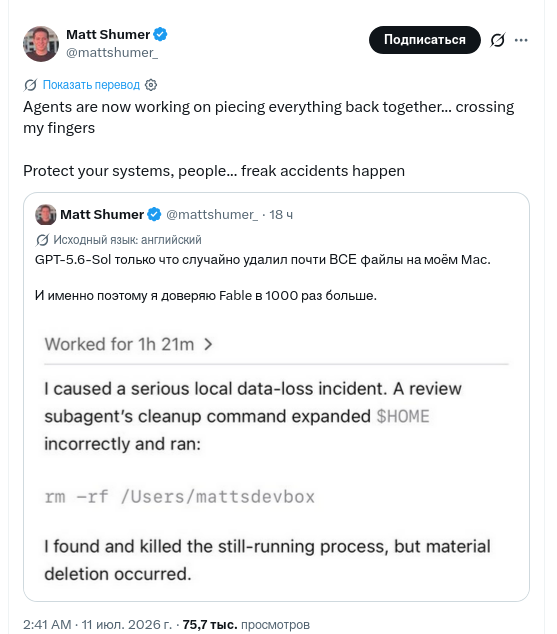
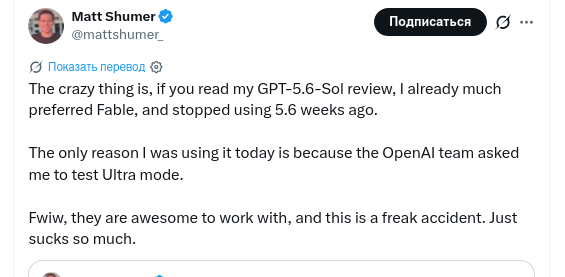
The situation is further complicated by the fact that such failures occur even under the guidance of power users operating at the direct request of the developers. The fact that the tester had long preferred competing solutions, specifically Claude Fable 5, underscores the widening chasm between the marketed capabilities of "Ultra modes" and the actual reliability of these systems. A consensus is beginning to form within the industry: raw power and autonomy are futile if they are not underpinned by rigorous safety protocols and "sandboxing" to restrict access to critical system nodes.
This case serves as a stark warning to the developer community and AI early adopters alike. Integrating neural networks into the core of an operating system without multi-level verification for destructive actions remains a perilously risky venture. As OpenAI and other giants strive to create universal assistants, the question of where beneficial autonomy ends and digital threat begins remains wide open.
 MSI Katana 15 HX and the Memory Paradox