The market for paleontological rarities has reached its zenith with the record-breaking $50 million sale of a Tyrannosaurus rex skeleton. This milestone signals a definitive shift, transforming ancient remains from instruments of pure scientific inquiry into high-value luxury assets for private collectors. Yet, beneath this financial triumph lies a profound tension between commercial interests and the academic pursuit of truth. Access to Earth’s prehistoric record is increasingly dictated not by a specimen's scientific merit, but by the purchasing power of the highest bidder.
New York’s Sotheby’s auction house recently played host to one of the most high-profile transactions in the history of natural science. A Tyrannosaurus rex skeleton nicknamed "Gus" went under the hammer for $50.1 million, shattering even the most optimistic expert valuations, which had hovered between $20 million and $30 million. This result does more than just set a new financial benchmark; it underscores the ascending status of fossils as ultra-high-net-worth luxury assets.
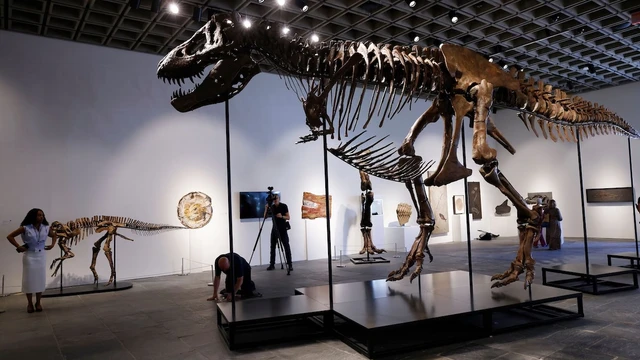
The saga of Gus began on the lands of farmer Gary Licking in Harding County, South Dakota. The process of extracting the remains from the earth was an arduous undertaking that spanned several years, from 2021 to 2023. The result is one of the most complete and massive skeletons of this apex predator ever discovered. The specimen's dimensions are staggering: measuring approximately 11.5 meters in length and 3.8 meters in height, the dinosaur was a colossal force of nature. The scale was so immense that the original skull proved too heavy for standard mounting; consequently, it was exhibited separately in the Sotheby’s lobby, while a high-fidelity reproduction took its place in the primary assembly.
From a technical standpoint, Gus's value is driven by an exceptional degree of preservation. The skeleton comprises 183 fossilized bone elements. Of particular significance to paleontologists is the presence of 30 out of 32 gastralia—the rare abdominal ribs that supported the internal organs of the predator's massive torso. In numerical terms, the skeleton is approximately 61% complete; however, in terms of total bone mass, this figure reaches 75–80%. A further advantage is the preservation of all six tooth rows in the skull, allowing for a detailed study of the jaw morphology of one of the Cretaceous period's most lethal hunters.
Yet, Gus is prized not only for his structural integrity but for the "biographical code" encrypted within his bones. Analysis of the remains revealed a series of pathologies that testify to a brutal struggle for survival. Bite marks from other tyrannosaurids were discovered on the skull, lower jaw, and various other skeletal elements. These injuries may have been the result of territorial disputes between conspecifics or the work of scavengers following the animal's death. Furthermore, fractures found on the ribs and gastralia show evidence of complete healing during the animal's lifetime, demonstrating the organism's capacity for regeneration even after severe trauma.
This commercial triumph—which eclipsed the previous record held by "Apex" the Stegosaurus (sold in 2024 for $44.6 million)—has sparked serious alarm within academic circles. Paleontologists, including Richard Butler of the University of Birmingham, warn of a systemic crisis: when fossils become objects of speculation, they slip beyond the reach of museums and research institutions. Science is losing access to critical evidence of evolution, as state and university budgets simply cannot compete with the capital of private collectors.
The situation is further exacerbated by jurisdictional disparities. In the United States, where Gus was discovered, legislation allows fossils to be treated as private property, paving the way for their open sale. Conversely, in countries such as Brazil or Mongolia, all paleontological finds are legally designated as state property. This legal dualism creates grey zones in the international market and jeopardizes the preservation of global natural heritage for the sake of short-term auction house profits.
 The Foldable iPhone: A New Chapter for Apple