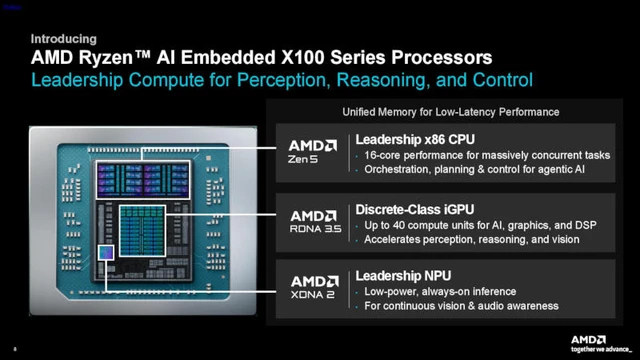
Modern robotics is evolving beyond rigid, hard-coded algorithms toward the paradigm of embodied AI—a shift that demands immense computational power directly on the edge. The conventional architectural divide between the CPU, GPU, and NPU introduces critical latencies that are untenable for real-time applications. The AMD X100 seeks to shatter this bottleneck by deeply integrating all compute resources onto a single die. This strategic pivot transforms the robot from a passive executor of commands into a truly autonomous agent capable of instantaneous environmental perception and analysis.
The autonomous systems industry is facing a fundamental bottleneck: the need for high-performance computing constrained by stringent power envelopes and limited physical footprints. AMD’s answer to this challenge arrives in the form of the X100 series—hybrid chips that are essentially industrial-grade derivatives of the Strix Halo APU architecture. Unlike consumer-grade silicon, these processors are engineered for 24/7 operation with a projected ten-year lifecycle, making them viable for heavy-duty industrial applications and complex robotic systems.
The lineup consists of three configurations scaled for varying workloads. The flagship X199 integrates 16 Zen 5 cores and 40 RDNA 3.5 compute units, delivering maximum throughput for computationally intensive tasks. The X188 and X168 offer more balanced alternatives with 12 and 8 cores respectively, while maintaining a robust graphical capability of 32 compute units. The technical specifications are formidable: boost clocks reach 5.1 GHz, and support for up to 128 GB of unified memory allows the system to process massive datasets without the latency bottlenecks inherent in traditional CPU-GPU data transfers.
Particular emphasis has been placed on neural processing. An integrated XDNA 2 coprocessor, delivering up to 50 TOPS, handles local AI model inference. System flexibility is ensured via a configurable TDP ranging from 45W to 120W, coupled with extreme environmental resilience—the chips maintain stability in temperatures ranging from -40°C to +105°C.
The competitive landscape centers on the concept of integration. While Intel’s Panther Lake also pursues resource consolidation, AMD is betting on a larger die area and a higher count of silicon components. This allows the X100 to tackle more resource-heavy tasks that demand high compute density.
A comparative analysis between the flagship X199 and the Intel Core Ultra X7 358H reveals a distinct advantage for AMD in synthetic benchmarks. In GeekBench 6.1 and PassMark, performance is 20–30% higher; in integer-heavy workloads like SPECrate 2017, the gap widens to 50%. The RDNA 3.5 graphics subsystem also dominates, with Vulkan and OpenGL metrics performing 1.4–1.7 times better than Intel’s Arc B390 solutions.
For robotics, the most critical metric is Time to First Token (TTFT) when running large language models. Here, the X100 demonstrates a 1.4x reduction in latency, while token generation speeds in Llama benchmarks increase by 3.5x. It should be noted that these tests are partially predictive, as AMD extrapolated competitor performance based on public data; while this makes direct comparisons debatable, the overall trend toward increased efficiency is undeniable.
However, the chip is only one part of the equation. For real-world deployment, AMD offers the Kria System on Module (SOM), a platform utilizing the COM-HPC form factor. This is a complete compute node augmented by Spartan UltraScale+ FPGA programmable logic. This combination enables the creation of custom interfaces for sensors and industrial networks, ensuring the deterministic data throughput that standard processors simply cannot provide.
The primary obstacle to AMD's expansion remains the Nvidia CUDA ecosystem, which has become the de facto standard for AI development. To attract developers, AMD is deploying HIPIFY, a tool that automates the migration of code from CUDA to HIP C++. Evidence suggests that up to 80% of application porting effort can be automated, significantly lowering the barrier to entry for those transitioning to the X100 platform.
In the long term, AMD aims to build a comprehensive "intelligent stack" for humanoid robotics. This strategy involves the synergy of X100 chips with Zynq UltraScale+ and Versal AI Edge Gen 2 programmable chips, creating a truly adaptive control system capable of autonomous learning and seamless interaction with the physical world.
 The Triumph of 3nm Chip Manufacturing