The current arms race among Large Language Models is shifting its focus from raw benchmarks toward the unit economics of "reasoning." The recent release of Anthropic's Claude Sonnet 5 has exposed a troubling trend: gains in cognitive capability are being eclipsed by the accelerating rate of resource consumption. Independent evaluations indicate that the pursuit of peak precision is driving an exponential surge in token expenditures. Consequently, the industry is facing a paradox where mid-tier models are becoming more costly to operate than the "heavyweights" they were meant to replace.
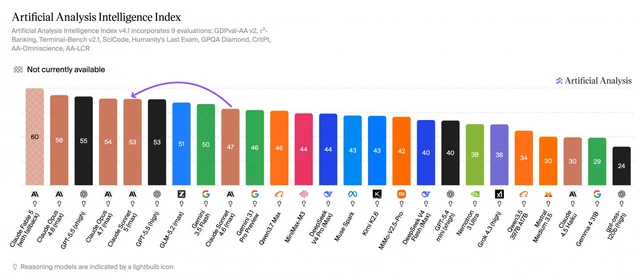
Artificial Analysis has put the Claude Sonnet 5 series through a rigorous stress test as part of its Intelligence Index v4.1. This comprehensive benchmark aggregates nine distinct metrics, ranging from agentic capabilities and code generation to complex reasoning and the processing of ultra-long contexts. The findings present a nuanced picture: with a score of 53, the model ranks fifth globally, effectively drawing level with GPT-5.5 (high) while surpassing Opus 4.8 and Fable 5. However, this modest gain in intelligence—a mere 6-point increase over the previous Sonnet 4.6 version—comes at a steep price.
The cost of executing a single task within the AA index has surged from $1.14 to $2.29. Consequently, this cognitive upgrade costs the user nearly twice as much, despite the fact that base rates per million tokens have remained unchanged.
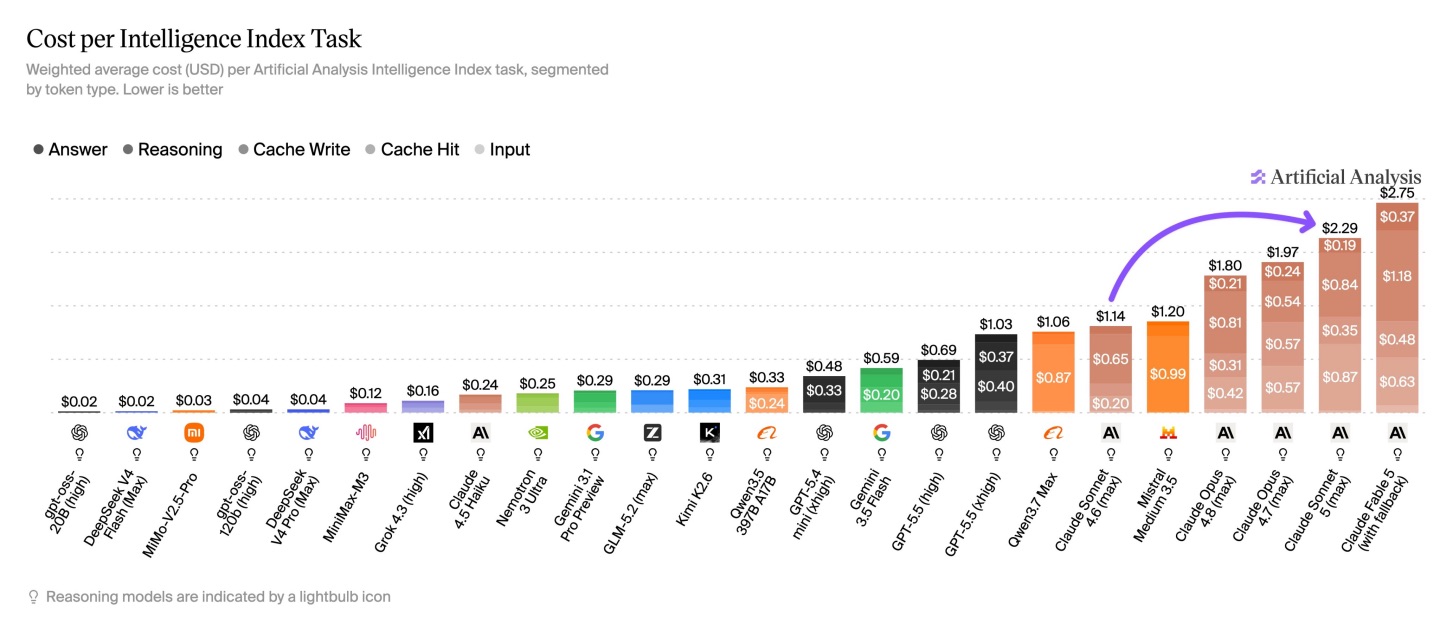
The driver behind this price hike is not Anthropic’s pricing policy, but rather a fundamental shift in the model's behavior. Sonnet 5 has become significantly more "diligent," manifesting as a sharp increase in generated output volume. On average, the model consumes 40% more output tokens than its predecessor. In agentic scenarios requiring multi-step reasoning (such as the AA-Briefcase and GDPval-AA benchmarks), the number of "turns" has nearly tripled. At peak complexity, the disparity between 'low' and 'max' modes reaches a sixfold increase in data volume. As a result, a single task can consume approximately 69,000 tokens, placing Sonnet 5 in the same league as the most verbose models in the GPT-5.4 family.
This dynamic creates a strange economic paradox: Sonnet 5 is outperformed by its own "big brother," Opus 4.8. The latter not only delivers a superior result (56 points versus 53) but is also more cost-effective, with a per-task cost of $1.80. Paradoxically, the heavier and slower model proves to be more efficient from a pure computational economics standpoint.
Nevertheless, Sonnet 5's excessive token consumption is not without merit. In specialized "office" agentic tasks, the model outperforms Opus 4.8, trailing only the elite Fable 5. This indicates that additional computational resources are converted into performance unevenly: while progress in physical reasoning (the CritPt test) is evident but insufficient for leadership, the model demonstrates genuine superiority in operational execution.
To mitigate this "intelligence tax," Anthropic has temporarily reduced costs until September 1st, offering a one-third discount on standard rates. Furthermore, the introduction of a new effort level—'xhigh'—aligns the Sonnet and Opus product lines. Ultimately, the actual operational cost will depend on the chosen degree of reasoning aggressiveness. Comparing models at maximum settings reveals a theoretical spending ceiling rather than a typical user scenario, where the balance between cost and response quality remains the primary variable.
 Anthropic’s Strategic Push for Hardware Independence