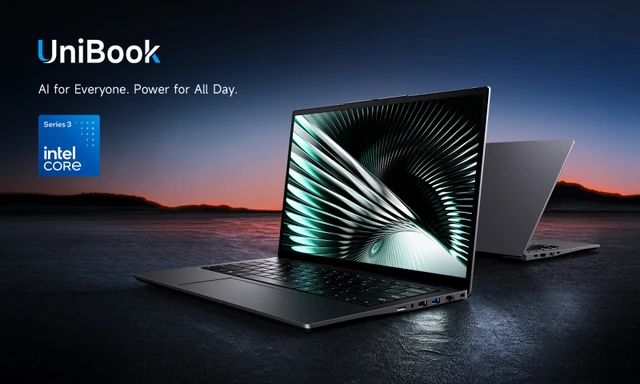
The contemporary PC market is undergoing a fundamental paradigm shift toward the "AI PC" concept, migrating neural processing from remote cloud servers directly to the edge device. For years, such capabilities were the exclusive domain of prohibitively expensive flagships; however, Intel's latest silicon innovations are rewriting the rules of engagement. Chuwi is making a bold move by integrating this cutting-edge hardware into an accessible form factor. The UniBook is evolving beyond a mere budget-friendly tool; it represents a concerted effort to democratize local artificial intelligence, transforming it into a mainstream commodity.
At the heart of the new UniBook lies the Intel Core 3 304 processor, engineered using the cutting-edge Intel 18A process. The shift to this node delivers more than just increased transistor density; it yields a significant leap in power efficiency—a critical metric for the ultrabook category. A standout feature of the silicon is the integrated Neural Processing Unit (NPU), boasting performance up to 15 TOPS. When paired with the Intel Graphics core, capable of delivering up to 9 TOPS in Int8 operations, the device establishes a robust architectural bedrock for Windows 11 AI features—such as intelligent background blur, noise suppression, and local LLM execution—without taxing the primary CPU.
The visual experience is driven by a 14-inch IPS display with WUXGA resolution (1920 × 1200). The deliberate choice of a 16:10 aspect ratio over the traditional 16:9 is a clear nod toward productivity, as the additional vertical real estate streamlines workflows for document editing and coding. With 100% sRGB color coverage and a brightness of 300 nits, the panel is well-suited for entry-level content creation, while the 180-degree hinge adds a layer of versatility to various usage scenarios.
The internal specifications are finely tuned for the demands of a modern professional or student. The machine is equipped with 8 GB of LPDDR5-6400 RAM; here, the high memory frequency is pivotal, as bandwidth directly dictates the performance of both the integrated graphics and the neural accelerator. A 256 GB SSD provides baseline utility, and the fact that it is expandable eliminates one of the most common pain points found in budget-tier laptops.
Endurance is handled by a 53.38 Wh battery. In local Full HD video playback mode, the device can operate for up to 13 hours. Combined with 65W USB-C Power Delivery support, the UniBook transforms into a truly mobile tool. Weighing just 1.2 kg with a thickness of 16.4 mm, the laptop remains nearly imperceptible in a backpack.
The connectivity suite deserves particular mention; it appears surprisingly generous for such a compact chassis, yet proves immensely practical. The onboard I/O includes two full-function USB-C ports and three USB-A ports (two of which operate at 5 Gbps), obviating the need for cumbersome dongles. The inclusion of a Gigabit Ethernet RJ45 port and a TF card slot underscores a commitment to pragmatism. Furthermore, the ability to drive two external 4K monitors at 60 Hz effectively elevates the UniBook into a legitimate workstation.
Rounding out the feature set are Wi-Fi 6, Bluetooth 5.2, and an HD camera equipped with a mechanical privacy shutter. Running Windows 11 Pro and backed by an aggressive pricing strategy—starting at $449—the UniBook positions itself as one of the most accessible gateways into the era of modern AI PCs.
 The Evolution of the Apple Home Ecosystem