The quest for extraterrestrial life has long been constrained by our inability to definitively confirm the presence of atmospheres on small, rocky planets. For decades, astronomers have relied on proxy data and theoretical models, chasing the elusive prospect of a true Earth analog. However, a recent breakthrough in the study of exoplanet LHS 1140-b is shifting the very paradigm of how we search for habitable worlds. The detection of helium traces provides the first direct evidence that rocky planets situated within the habitable zone are indeed capable of retaining an atmospheric envelope.
The challenge of detecting exoplanetary atmospheres has always been a matter of scale: small, rocky worlds are effectively drowned out by the blinding radiance of their host stars. For years, scientists were only able to identify gaseous envelopes around gas giants or planets orbiting far beyond the habitable zone—regions where the conditions for life, as we understand it, are virtually impossible. In the case of rocky worlds, astronomers had to rely on indirect data, such as moderate temperature differentials between a planet's day and night sides. While suggestive of an atmosphere, such data fell short of definitive proof.
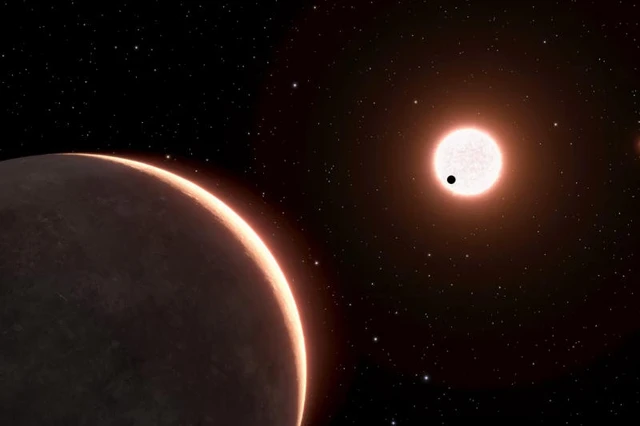
The spotlight has now fallen on LHS 1140-b, a world approximately 5.6 times more massive than Earth, orbiting a red dwarf 48 light-years away. To confirm the presence of an atmosphere, researchers employed an innovative method based on the effect of mass fractionation. This physical process dictates that lighter atoms and molecules escape into deep space more rapidly than heavier elements. Leveraging this model, scientists hypothesized the existence of planets with dense surface atmospheres and rarefied upper layers through which helium could leak.
Empirical validation of this theory required a series of observations conducted throughout 2024 and 2025. The analysis of the LHS 1140 system yielded starkly contrasting results for its two planets. A distinct helium signature was detected from LHS 1140-b, confirming the existence of a gaseous envelope. Notably, the intensity of this signal fluctuated over time, indicating a dynamic gas leak and suggesting that the planet's atmosphere may have persisted for several billion years. Conversely, the neighboring planet, LHS 1140-c, showed no signs of an atmosphere, aligning perfectly with theoretical predictions based on its orbital characteristics.
This discovery is fundamental to modern astrobiology. Red dwarfs are far more prevalent in the universe than G-type stars like our Sun; proving that rocky worlds orbiting them can retain an atmosphere exponentially increases the probability of discovering extraterrestrial life.
LHS 1140-b is now regarded as one of the most promising candidates for a habitable world, as it meets three critical benchmarks: a solid surface, a temperature regime conducive to liquid water, and a protective atmosphere that shields the surface from harsh cosmic radiation. Although the Hubble and James Webb orbital observatories have yet to detect direct biosignatures, this world has become a priority target for further deep-space analysis.
 BepiColombo’s Odyssey: At the Threshold of the Sun