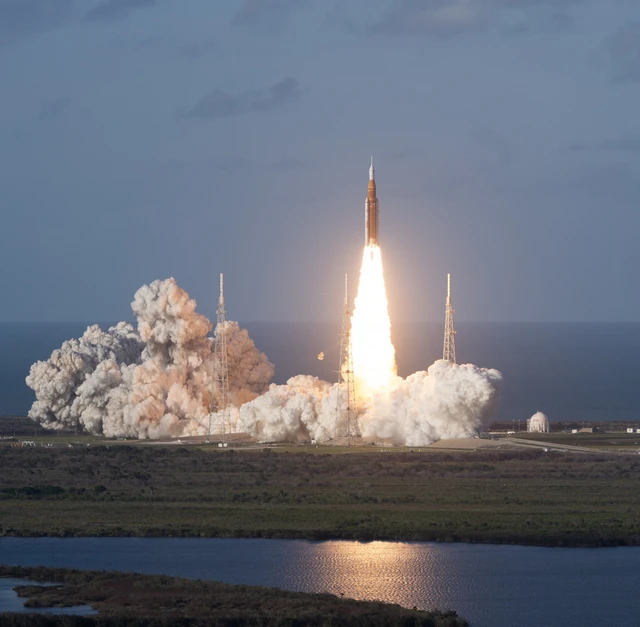
The long-held ambition of capturing high-fidelity, real-time imagery of the lunar surface has finally transitioned from vision to technical reality. The Artemis II mission was far more than a mere reconnaissance flight; it served as a rigorous, large-scale stress test for next-generation communication architectures. By synthesizing years of advancements in laser optics with the scalability of cloud computing, engineers successfully beamed 4K video across the cosmic void. This breakthrough establishes the critical infrastructure for future crewed expeditions and paves the way for a new era of global consumption of high-definition space media.
Deep space communications have long been tethered to radio waves—a reliable medium, yet one plagued by severe bandwidth bottlenecks. To shatter this ceiling and enable 4K-resolution streaming, NASA engineers deployed the O2O (Orion Artemis II Optical Communications System) laser terminal. The culmination of over two decades of research and development, this technology achieves data transfer speeds of up to 260 Mbps. This throughput is substantial enough to simultaneously broadcast high-definition video while transmitting critical telemetry, voice communications, and massive scientific datasets without latency or packet loss.
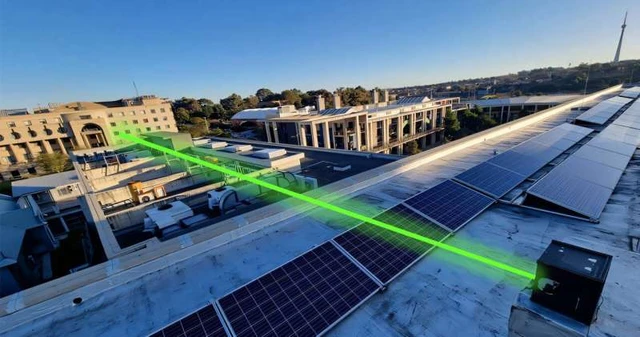
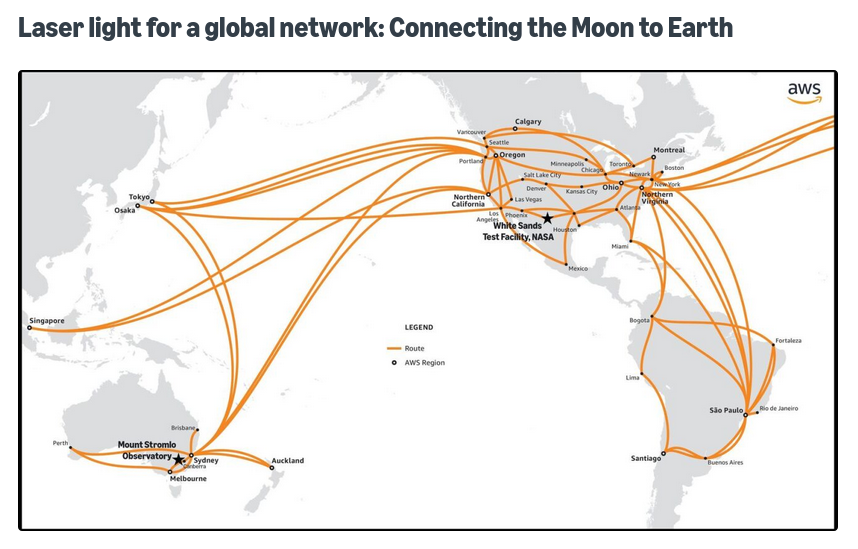
The signal's journey from the Orion spacecraft to the end user followed a sophisticated, multi-stage relay. Data was captured by two primary ground stations: the Mount Stromlo Observatory in Australia, handling Southern Hemisphere trajectory segments, and the White Sands complex in New Mexico. The most striking aspect of this architecture was the deployment of the network route between these nodes. While the system's hardware took decades to engineer, the software-defined network (SDN) leveraging the AWS global backbone was deployed in a matter of weeks. Approximately 15,000 kilometers of fiber-optic cabling linked the two continents at a minimal implementation cost, highlighting the staggering disparity between the expense of specialized aerospace hardware and the accessibility of modern cloud infrastructure.
Once the signal reached White Sands, it entered a media pipeline powered by AWS Elemental services. The processing workflow was bifurcated into two critical stages: live stream encoding via MediaLive and fault-tolerant content delivery to partners via MediaConnect. This architecture enabled the seamless distribution of the video feed across NASA+, YouTube, and Prime Video, reaching an audience of 25 million people. A fundamental requirement of the mission was total data transparency, transforming the launch, lunar flyby, and splashdown into a globally accessible event.
However, the role of cloud computing extended far beyond public relations. The immense computational heavy lifting required for crew safety was migrated to the AWS GovCloud environment. Calculating a lunar trajectory demands tens of thousands of simulations to account for both nominal operations and potential emergency scenarios. Engineers at the Johnson Space Center generated between 2 and 5 TB of data for every launch window. By utilizing cloud infrastructure, NASA could dynamically scale its computing power, spinning up hundreds of instances during peak loads. This capability ensured that Orion's course corrections were performed in near real-time during the critical first 48 hours post-launch.
The success of Artemis II serves as a full-scale dress rehearsal for Artemis IV, which aims to achieve the first human lunar landing in half a century. The expertise gained in building this hybrid communication and computing ecosystem will allow NASA to prepare for even more grueling workloads. By the time of the landing, the live streaming audience is expected to grow tenfold, reaching an estimated 250 million viewers—a scale that will demand even more sophisticated global content distribution strategies.
 The Endurance Potential of the Vivo V80 Lite 5G