The global AI arms race is evolving, shifting from a period of sporadic breakthroughs toward a disciplined, rhythmic cycle of iterative development. AMD is pivoting its strategy, adopting an annual release cadence for its Instinct accelerators and Helios rack-scale solutions. This strategic shift is designed to systematically close the technological gap with the market leader while providing hyperscalers with a predictable roadmap for infrastructure scaling. Central to this ambition is the aggressive integration of next-generation memory standards and high-performance networking protocols.
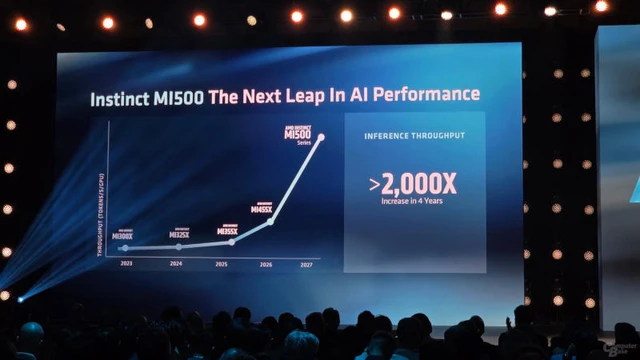
The contemporary high-performance computing (HPC) landscape demands more than raw power; it demands a predictable evolutionary trajectory. AMD is addressing this need by transitioning its Instinct accelerator lines and Helios infrastructure solutions to an annual update cycle. The current phase is defined by the rollout of the MI400 family, where flagship models such as the MI455X serve as the foundation for Helios rack configurations. However, the true technological leap is anticipated in 2027 with the debut of the MI500 series.
Performance projections for the MI500 are ambitious: the company claims a staggering 2,000-fold increase in efficiency compared to the MI300X released in 2023. Such rapid progress over four years will be driven by the transition to a 2nm process and the implementation of HBM4E memory standards from Samsung and SK hynix. Of particular note is the networking layer: for the first time, the MI500 series will integrate optical interconnects, radically reducing data latency between chips and overcoming the physical bottlenecks inherent in traditional copper interfaces.
In terms of market positioning, AMD is banking on a strategic gap in its competitor's roadmap. While Nvidia is not expected to release its Feynman platform until 2028, the MI500 will serve as the primary counterbalance to the Rubin architecture. This creates a window of opportunity where AMD’s subsequent generation—the MI600 series based on CDNA Next—will enter direct competition with Feynman, effectively maintaining parity or even securing leadership during key intervals.
However, AMD's strategy extends beyond the production of individual silicon. The company is pivoting toward the delivery of comprehensive ecosystems: the Helios AI Racks, which unify compute power, network controllers, and central processors into a single architectural entity. Industry giants such as Microsoft and Anthropic are already integrating these solutions into their infrastructure.
By 2027, current systems will be superseded by the AMD Helios 500. Its computational core will consist of energy-efficient Epyc 9006 processors from the Verano family, built on the Zen 6 architecture. The networking stack will be powered by Pensando Como controllers and specialized Monza processors, ensuring the seamless orchestration of massive datasets.
The strategic horizon extends to 2028 with the expected debut of the AMD Helios 600 platform. This iteration will feature the aforementioned MI600 accelerators and Ferrara CPUs—an energy-efficient modification of Florence based on Zen 7. Network connectivity will be handled by next-generation Pensando solutions, such as Palma and Levanzo. Through this approach, AMD is constructing a vertically integrated stack where every component—from the transistor in the accelerator to the network switch in the rack—is updated synchronously, creating a formidable tool for training and deploying next-generation AI models.
 The Triumph of 3nm Chip Manufacturing