The exploration of Mars has long transcended the realm of mere technical challenge, evolving into a sweeping archaeological odyssey in search of remnants of ancient life. Central to this endeavor has been the Curiosity rover, a pivotal instrument that has spent the last decade pushing the boundaries of our understanding of planetary evolution. Surpassing the milestone of five thousand sols marks a fundamental shift: moving beyond initial reconnaissance of the Martian landscape toward a profound analysis of its geological epochs. This anniversary underscores the extraordinary resilience of terrestrial technology when pitted against the harsh realities of cosmic vacuum and relentless radiation.
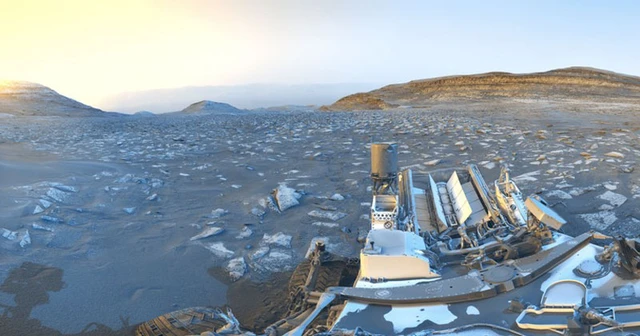
Since August 2012, the Curiosity rover has maintained an uninterrupted vigil over the surface of the Red Planet, evolving from a mere exploratory probe into a fully realized autonomous laboratory. A recent milestone—the 5,000th Martian day (sol)—was commemorated with the creation of a unique visual document from Gale Crater. This image, serving as a sort of "postcard" from Mars, is more than just a panorama; it is a sophisticated synthesis of data capturing the surroundings of the "Chocolate" sand dunes at the base of Mount Sharp.
The technical execution of this shot highlights the elegant approach NASA engineers take toward data processing. The image was constructed by merging two monochrome frames captured by the rover's navigation cameras at different intervals: one taken on the morning of August 30, 2026, and the other on the evening of September 2. To emphasize the temporal contrast and add artistic depth, color filters were applied during post-processing: cool blue hues for the morning segment and warm golden tones for the evening.
At the bottom of the composition, elements of the rover itself are clearly visible, serving as a reminder of its complex engineering. Specifically, the communication antenna and the radiators of the Radioisotope Thermoelectric Generator (RTG) are prominent. This unit acts as the "heart" of Curiosity, converting the heat from the decay of plutonium-238 into electrical power. This allows the rover to operate independently of solar activity and the dust storms that frequently disable solar-powered missions.
Yet, the true value of the Curiosity mission lies not in the aesthetics of its imagery, but in its fundamental scientific breakthroughs. Throughout its tenure on Mars, the rover has meticulously analyzed ancient sedimentary rocks, uncovering irrefutable evidence that the planet once possessed conditions conducive to the emergence of life.
The rover's trajectory is essentially a vertical journey through time. Having ascended more than a kilometer from its landing site, Curiosity continues its climb up the slopes of Mount Sharp. Each new geological layer analyzed by the probe serves as a page in the chronicle of Martian climatic shifts, revealing the planet's transformation from a warm, wet world into a frozen wasteland. Thus, this celebratory panorama is not only a symbol of technological endurance but a visual testament to the monumental journey humanity has undertaken to unravel the mysteries of our neighboring world.
 The Awakening of the Nancy Grace Roman Observatory