For decades, nuclear fusion has been pursued as the "holy grail" of global energy. Yet, the primary bottleneck hindering its commercialization remains the inherent inefficiency of converting heat into electricity. Conventional steam-turbine architectures are both unwieldy and inefficient, severely undermining the economic viability of such reactors. US-based startup Realta Fusion has introduced a disruptive approach to bypass this limitation, demonstrating a technology capable of extracting current directly from plasma. This breakthrough signals a pivotal shift from theoretical modeling to the practical realization of direct energy conversion.
The prevailing architecture of contemporary fusion power plants remains stubbornly tethered to 19th-century thermodynamics: heating a coolant, generating steam, and driving massive turbines. This cascade of energy conversions inevitably results in substantial losses. Realta Fusion, in collaboration with the University of Wisconsin-Madison, has sought to bypass this inefficiency using the WHAM (Wisconsin HTS Axisymmetric Mirror) experimental device. Test results conducted in June 2026 have confirmed the feasibility of extracting electrical current directly from the products of a nuclear reaction.
At the core of the WHAM device is the principle of a linear magnetic confinement system, known in physics as a "magnetic mirror" or "plug." In such a system, plasma is contained by powerful magnetic fields at the device's extremities. However, perfect confinement is an impossibility; a portion of the charged particles inevitably "leaks" through the magnetic throats. While classical research viewed this leakage as a critical flaw, the engineers at Realta Fusion have transformed it into a primary advantage by installing a direct conversion system within the particle exit zone.
The technical implementation of this process utilizes a single-stage electrostatic conversion system integrated into the device's end ring. The converter consists of three fine-mesh grids: a grounded grid, an electron-repelling grid, and a final ion-collector grid. As charged particles, including alpha particles, escape the magnetic trap, they encounter the electric field of the collector. At this point, their kinetic energy is decelerated and converted into an electrical charge on the electrode, generating a current in the external circuit.
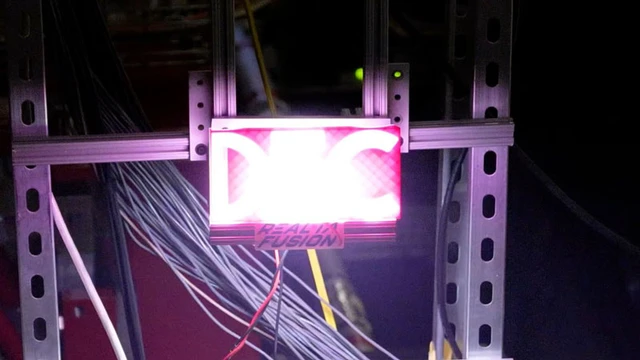
During the demonstration, the system produced a current of several amperes at a voltage of approximately 100V. While this volume of energy is only sufficient to power a handful of lightbulbs, the successful Proof of Concept is of fundamental importance to the industry.
In the long term, Realta Fusion aims to develop a full-scale Deuterium-Tritium (D–T) reactor. The specific nature of such a reaction dictates the energy distribution: approximately 80% of the energy is carried by neutrons, which, being uncharged, cannot be captured by an electrostatic converter. This portion of the energy must still be extracted via a thermal blanket and a traditional steam cycle. However, the remaining 20%, carried by charged alpha particles, can now be converted directly into electricity.
This hybrid architecture allows for a significant optimization of the reactor's energy budget. The directly extracted energy can be routed to power the plasma containment systems and magnetic coils, drastically reducing the need for external power and enhancing the overall commercial viability of fusion energy. This public demonstration marks the first instance in the private sector where fusion energy was converted into electricity while bypassing the thermal cycle entirely.
 Drones for Cloud Cover Management Over Solar Power Plants