The global space launch industry is on the cusp of a tectonic shift in orbital logistics. For years, the Falcon 9 has served as the benchmark for reliability and cost-efficiency, effectively monopolizing the commercial launch market. Now, however, SpaceX is signaling an aggressive pivot toward an era of total reusability—a strategic maneuver that transforms Starship from an ambitious experiment into the company's primary vehicle for deep-space expansion.
The aerospace landscape is shifting: SpaceX has begun restricting Falcon 9 launch orders scheduled beyond 2028. According to Bloomberg, the company has ceased accepting even long-term requests for its rideshare program—the service where a single vehicle deploys payloads for multiple customers. This move effectively signals that the era of modern rocketry's "workhorse" is drawing to a close, making way for the Starship system.
From an operational standpoint, this move appears remarkably bold. While the Falcon 9 is one of the most reliable rockets in history, it remains only partially reusable; its upper stage is invariably lost to atmospheric reentry or left in orbit. Transitioning to Starship implies full reusability for both stages, fundamentally altering launch economics. To facilitate this pivot, reports suggest SpaceX has already begun scaling back production of Falcon 9 upper stages and associated components. In essence, the company is consciously burning its bridges, abandoning a proven technology in favor of a system still undergoing active flight testing.
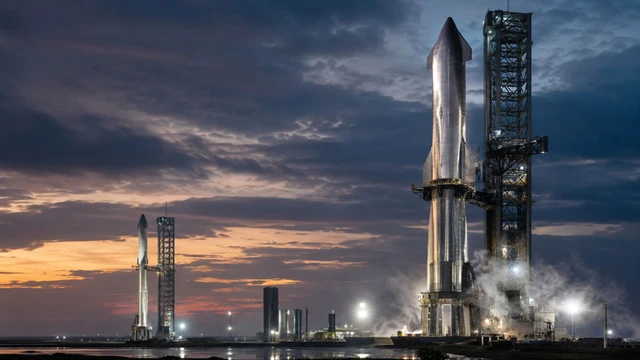
The disparity in capability between the two systems is staggering. The Starship and Super Heavy combination is designed to deliver over 100 tons of payload to low Earth orbit (LEO)—a capacity that dwarfs that of the Falcon 9. Such power is critical not only for deploying next-generation Starlink constellations but also for realizing the vision of orbital data centers and hosting ultra-heavy commercial payloads.
However, the path to operationalizing Starship is fraught with significant technical hurdles. For the system to become a viable transport vehicle, SpaceX must solve several fundamental problems: ensuring the flawless performance of the heat shield during reentry, establishing rapid turnaround times between launches, and—most critically—mastering orbital cryogenic refueling. Without these milestones, Starship remains an impressive prototype rather than an industrial tool.
Simultaneously, the Falcon 9 is expected to retain a role in specialized NASA and U.S. Department of Defense missions, where requirements for predictability and safety preclude the use of experimental systems. For the commercial sector, however, the outlook is more precarious. Many satellite operators have become profoundly dependent on SpaceX's infrastructure, as there are virtually no alternative launch vehicles of comparable class and cadence currently available on the market.
Ultimately, the company is wagering that within the next eighteen months, Starship will evolve from a series of high-risk test flights into a reliable, production-ready system. Should this transition fail to materialize by 2028—and with Falcon 9 production permanently halted—the global market could face an acute deficit in orbital access and payload delivery capabilities.
 BepiColombo’s Odyssey: At the Threshold of the Sun