The global AI arms race has propelled the semiconductor market into a regime of hyper-demand. Yet, the traditional sales model remains hostage to cyclical price volatility and supply chain instability. South Korean titan SK Group is proposing a radical departure from this impasse, fundamentally reimagining the very concept of hardware ownership. The company's strategy fuses aggressive expansion into the U.S. market with a strategic pivot toward a service-oriented model for memory consumption.
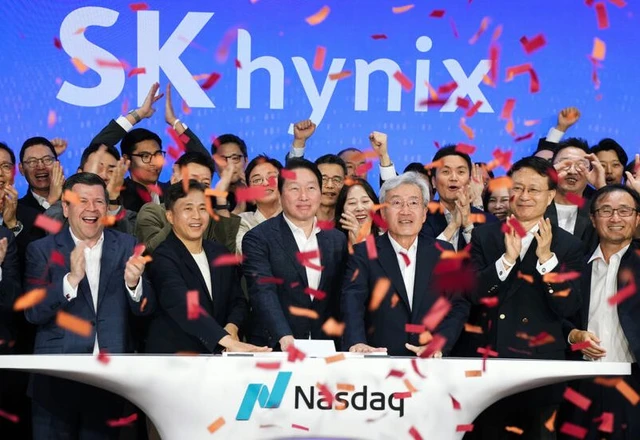
The strategic presence of SK Group's leadership in the United States, coinciding with the listing of its depositary receipts on the Nasdaq, has proven to be far more than a mere formality; it has served as a platform for declaring a new global strategy. At the heart of this initiative is a massive migration of production and technological capacities to American soil. This is not a series of isolated investments, but rather a systemic integration into the U.S. economy, with the conglomerate's current commitments already exceeding $35 billion.
These funds are being directed not only toward the expansion of the EV battery segment but also toward the creation of an advanced technological hub in Indiana, which will house cutting-edge memory chip testing and packaging processes. However, according to statements from SK Group Chairman Chey Tae-won, this figure represents only the baseline. The company intends to significantly scale its financial footprint in the region, effectively synchronizing its growth trajectory with U.S. government priorities regarding technological sovereignty in the semiconductor industry.
SK Group’s fundamental thesis on the memory market is inextricably linked to the evolution of artificial intelligence. From the leadership's perspective, a true equilibrium between supply and demand will only be achieved with the advent of Artificial General Intelligence (AGI)—a system whose cognitive capabilities are equivalent to those of a human. Until that milestone is reached, the industry will likely remain in a state of chronic shortage or turbulence, driven by the rapid deployment of neural networks.
To mitigate the inherent risks of the semiconductor business, SK Group is pivoting its transactional framework. Historically, the memory market has suffered from severe cyclicality, where periods of acute shortage are followed by price collapses. The proposed solution lies in long-term contracts that lock in supply volumes and pricing for years in advance. This approach allows the company to shift its financial planning from a reactive posture to a model of predictable development, where price volatility ceases to be the defining factor.
The most ambitious element of this new strategy is the transition toward a "Memory-as-a-Service" (MaaS) concept. Rather than relying on traditional hardware sales, SK Group is exploring a rental model. Under this framework, clients—primarily cloud providers and developers of large-scale AI models—could flexibly scale their capacity, leasing the necessary memory volumes during peak loads and returning them as demand subsides. This effectively transforms hardware into an elastic resource, optimizing capital expenditures for the consumer.
Parallel to this technological transformation, the company is refining its financial strategy within the American market. Provided exchange rates stabilize, SK hynix plans to increase the volume of its depositary receipts in the U.S. This move is designed not only to attract additional capital for expansion but to fully integrate the company into the financial infrastructure of the world's largest economy, creating a robust foundation for the implementation of its innovative business models.
 MSI Katana 15 HX and the Memory Paradox