The global shift toward electromobility has evolved beyond a mere race for battery capacity; it has become a battle for intellectual dominance. China, while already dominating the battery manufacturing landscape, has encountered a critical vulnerability: a profound reliance on foreign semiconductors. Amid escalating geopolitical tensions and the looming threat of sanctions, Beijing and the nation's leading automotive giants have launched an aggressive drive toward technological self-reliance. This strategy is redefining the vehicle, transforming it from a mere mode of transport into a sophisticated hardware-software ecosystem controlled entirely within domestic borders.
A modern electric vehicle in China is, for all intents and purposes, a supercomputer on wheels. The scale of the market is staggering: over 50 million vehicles, including hybrids, have already hit the roads, with millions more added to the fleet annually. Yet, beneath the veneer of this technological triumph lies a critical vulnerability. EVs require nearly twice as many semiconductors as traditional internal combustion engine (ICE) vehicles, with the cost of the silicon architecture in a single car reaching as high as $2,000.
For years, this demand was met by global titans: Taiwan's TSMC, South Korea's Samsung, and Germany's Infineon. These giants provided the most complex and sophisticated components. In recent years, however, the strategic focus has shifted. The risk of a sudden loss of access to foreign technology has become a powerful catalyst for Beijing's long-term industrial policy, aimed at achieving total autonomy in microelectronics.
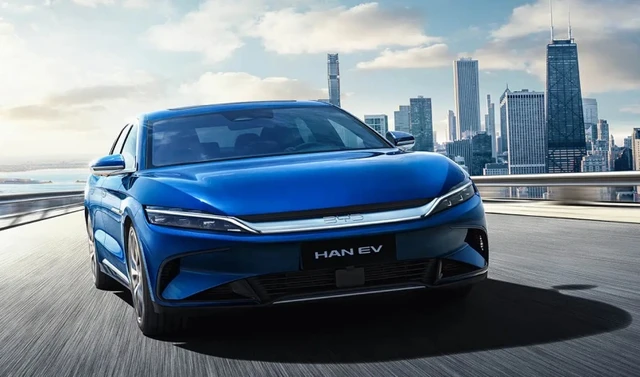
The most striking example of this transformation is the trajectory of BYD. The global leader in EVs has bet everything on aggressive vertical integration. By deploying a team of 7,000 researchers to develop the Xuanji A3—a proprietary chip for autonomous driving—the company has effectively neutralized its dependence on external suppliers for key components. This vertical model—spanning from the production of lithium iron phosphate (LFP) batteries to the design of in-house processors—allows BYD to not only slash costs radically but also significantly accelerate its development cycles, leaving Western competitors in the rearview mirror.
The technical superiority of these proprietary solutions becomes evident when analyzing efficiency. According to the developers, the Xuanji A3 demonstrates 20% lower power consumption while maintaining computational performance comparable to Nvidia's solutions. In an industry where every watt directly impacts a vehicle's range, such optimization is a critical competitive advantage.
BYD is not alone in this pursuit. A broad spectrum of leading Chinese brands—from Nio and Xpeng to Geely and Great Wall Motor—are now investing heavily in AI chip development. The financial incentives are as compelling as the political ones. Nio, for instance, claims that transitioning to in-house AI developments saves approximately $1,480 per vehicle produced.
To realize these ambitions, automakers are forging strategic partnerships with local semiconductor designers such as Huawei, Horizon Robotics, Black Sesame, and Oritek. This is fostering a new ecosystem that, in the long run, jeopardizes the revenue streams of American, European, and Japanese companies that have dominated the Chinese market for decades.
Nevertheless, the road to full sovereignty remains fraught with challenges. According to UBS, the market share of Chinese semiconductors in the automotive industry currently stands at around 15%. In the segment of cutting-edge AI accelerators essential for full autonomous driving, Nvidia still maintains a commanding lead. The transition from general-purpose chips to specialized ASICs (Application-Specific Integrated Circuits) requires colossal capital investment and profound software expertise.
Developing proprietary "silicon" is a high-stakes gamble. The exorbitant cost of R&D, the complexities of software integration, and the stringent safety requirements—where the cost of failure is measured in human lives—mean that not every player will survive. The market is likely to undergo a rigorous consolidation, leaving only a handful of companies capable of building a complete technological stack that can compete with global leaders on equal footing.
 The Dawn of the 2nm Era in the New iMac