The global race for dominance in Low Earth Orbit (LEO) is shifting from an era of experimentation to one of industrial-scale deployment. While Starlink currently defines the benchmark for satellite internet, China is methodically architecting its own strategic alternative. The recent launch of its 23rd batch of satellites underscores Beijing's resolve to establish a fully autonomous communications infrastructure. This is no longer merely a quest for technological parity; it is a high-stakes battle for digital sovereignty on a planetary scale.
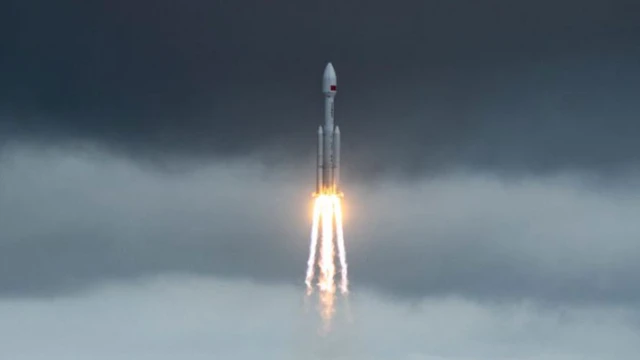
China's space program has entered a phase of aggressive orbital expansion. From the Wenchang Space Launch Center on Hainan Island, another Long March 8A carrier rocket successfully deployed the 23rd batch of satellites for its low-Earth orbit (LEO) communication system. While mission specifics—such as exact satellite counts and mass specifications—remain classified, the sheer regularity of these launches signals a shift toward an industrialized, assembly-line approach to constellation deployment.
The technological foundation of this operation lies in the vehicle's architecture. The Long March 8A is a two-stage liquid-propellant system standing approximately 50 meters tall with a formidable liftoff mass of 371 tonnes. The engineering is optimized for maximum efficiency: the first stage, comprising a central core and two side boosters, utilizes a conventional kerosene-liquid oxygen propellant combination to provide the necessary initial thrust. The second stage, with a diameter slightly exceeding three meters, employs a high-energy liquid hydrogen and oxygen mix—a critical choice for achieving precise payload insertion into target orbits.
Particular attention should be paid to the rocket's payload fairing. Its expanded diameter (5.2 meters) allows for the transport of massive satellite clusters, effectively turning the Long March 8A into a "space truck." With the capacity to deliver up to 7 tonnes of payload to a sun-synchronous orbit (SSO) at an altitude of 700 km, this vehicle has become the ideal instrument for the rapid scaling of China's orbital fleet.
Although official documentation avoids explicit naming, industry analysts unequivocally attribute these assets to the state-led "Guowang" (National Network) project. The ambition is clear: the creation of a global broadband network characterized by ultra-low latency.
Unlike traditional geostationary (GEO) systems, where satellites orbit at vast altitudes (approximately 36,000 km), LEO constellations operate significantly closer to Earth. This radically reduces signal propagation delay—a vital requirement for modern high-speed internet and cloud services. However, this architecture presents a significant challenge: because each satellite has a limited coverage footprint, thousands of units are required to ensure seamless, uninterrupted global connectivity.
Consequently, the current launch—the tenth mission for this specific rocket variant—is a key component of a broader strategy to establish dense "mesh" planetary coverage. China is not merely replicating Western models; it is establishing an industrialized cycle of deployment and orbital refreshment, ensuring total communication autonomy independent of terrestrial infrastructure or foreign service providers.
 Power Specifications: Oppo A7 Pro Max 5G