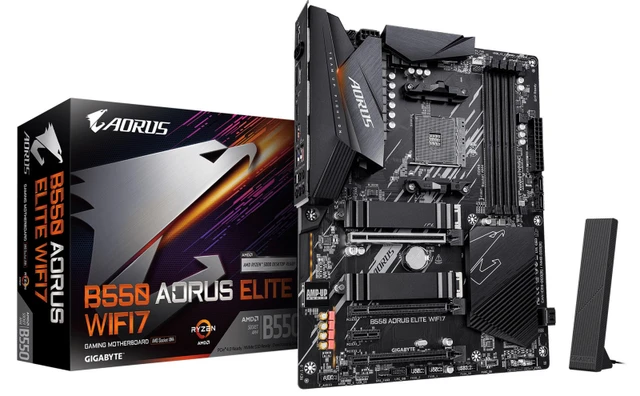
The AMD Socket AM4 platform has proven remarkably resilient, maintaining its relevance years after its initial debut. Amidst the rapid evolution of wireless technologies, upgrading these time-tested systems has become a strategic priority for many users. The introduction of the new B550 Aorus Elite WiFi7 motherboard is designed to revitalize this segment, bringing modern connectivity standards to a stable and proven hardware ecosystem. This solution seamlessly bridges the reliability of a classic chipset with cutting-edge data transmission capabilities.
The B550 Aorus Elite WiFi7 represents an evolutionary refinement rather than a radical redesign. Built upon the proven foundation of the B550 Aorus Elite AX V2, its primary pivot lies in the network interface. In an era where latency is a critical factor for gaming and streaming, the transition from Wi-Fi 6E to the Wi-Fi 7 standard feels justified, even for a previous-generation platform.
The wireless architecture is powered by the Realtek RTL8922AE module, which supports channel widths up to 160 MHz and the current Bluetooth 5.4 protocol—significantly expanding peripheral connectivity compared to earlier MediaTek or Realtek implementations. Beyond the internal silicon, the manufacturer has optimized ergonomics: traditional RP-SMA antenna connectors have been replaced by an EZ-plug system, considerably streamlining the assembly and setup process.
In terms of hardware fundamentals, the board maintains the ATX form factor and offers substantial power headroom. A robust 14-phase VRM (12+2 configuration) paired with a single 8-pin EPS connector ensures rock-solid stability for even the most power-hungry Ryzen 5000 series CPUs, effectively mitigating thermal throttling and voltage drops during sustained heavy workloads.
Data throughput follows the classic B550 topology. Four DIMM slots provide DDR4 support, while the PCIe lane distribution is optimized to extract maximum performance from the CPU. The primary PCIe 4.0 x16 slot and the first M.2 PCIe Gen 4 slot communicate directly with the processor, ensuring minimal latency for NVMe storage. Conversely, the second M.2 slot operates via the AMD B550 chipset under the PCIe 3.0 standard and shares bandwidth with a physical PCIe 3.0 x1 slot—a detail that necessitates careful planning when selecting additional peripheral devices.
The connectivity suite is rounded out by a Realtek 8125 controller, delivering wired speeds up to 2.5 Gbps, while audio fidelity is handled by the time-tested Realtek ALC1200 HDA codec. The I/O layout is well-balanced: the rear panel features a mix of USB 3.2 Gen2 (10 Gbps) and Gen1 (5 Gbps) ports, complemented by a front-panel USB-C header for rapid synchronization with modern mobile devices.
With an estimated price point below $180, the board's market positioning is clear: it is a compelling option for users not yet ready to migrate to the AM5 platform and its costly DDR5 memory, but who still demand cutting-edge wireless standards and uncompromising system stability.
 AMD’s Strategic Approach to the Budget Segment