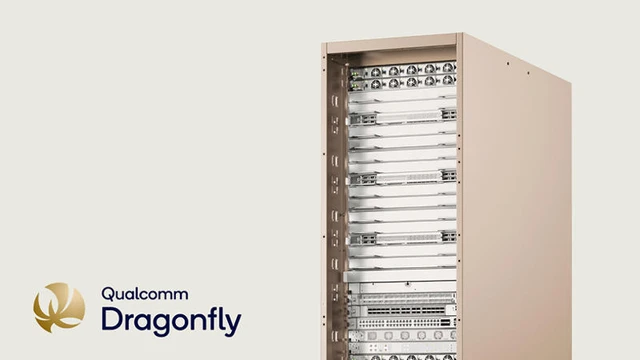
The artificial intelligence landscape is undergoing a fundamental paradigm shift: the era of simple chatbots is giving way to autonomous AI agents capable of executing complex, multi-step workflows independently. This evolution necessitates a radical overhaul of hardware architecture, as legacy computing paradigms struggle to keep pace with escalating workloads. Qualcomm, a long-standing titan of the mobile sector, is now pivoting its expertise in power efficiency toward the core of cloud infrastructure. The new Dragonfly ecosystem is engineered to recalibrate the equilibrium between raw compute power and memory bandwidth, posing a direct challenge to Nvidia's current market hegemony.
The shift toward Agentic AI marks a fundamental evolution: systems are moving beyond simple text generation to active interaction with the physical and digital world. This transition exponentially amplifies the demands for data processing speeds and power efficiency. In response, Qualcomm is betting on deep component integration, envisioning a paradigm where the CPU, accelerator, and memory operate as a single, highly optimized organism.
The cornerstone of this new strategy is the Qualcomm Dragonfly C1000 server processor. At its heart lie custom Oryon cores—already proven in the consumer segment—now scaled for industrial-grade workloads. Leveraging a chiplet architecture, a single die can integrate over 250 cores clocking in at speeds exceeding 5 GHz. This allows for a twofold increase in performance-per-watt compared to current market standards. To ensure seamless interoperability with peripherals and external memory, the C1000 integrates CXL and PCIe 7.0 interfaces, minimizing latency when transferring massive datasets. These processors are expected to hit the market in 2028.
However, even the fastest cores are rendered useless if they sit idle waiting for data from memory—a bottleneck known as the "memory wall." To dismantle this barrier, Qualcomm has introduced High Bandwidth Compute (HBC). This is the realization of the near-memory computing concept, where computational units and memory cells are merged into a single 3D structure. By radically reducing the physical distance a signal must travel, HBC emerges as a more efficient and faster solution than traditional HBM or LPDDR.
The practical impact of HBC is clearly demonstrated in the Dragonfly accelerator lineup. The AI250, slated for 2027, utilizes the first generation of HBC and promises an 18-fold leap in performance over its predecessor, the LPDDR5X-based AI200. Even more ambitious is the flagship AI300, arriving in 2028. Powered by HBC Gen 2, this accelerator will deliver a 54-fold increase in power. The AI300 will specialize in the inference of large language and multimodal models, offering significantly higher energy efficiency per watt than contemporary GPU solutions, particularly for latency-critical tasks.
Recognizing that the power of individual chips is ultimately capped by network bandwidth, Qualcomm is developing a comprehensive communication stack. The Dragonfly infrastructure includes 800G and 1.6T class interfaces, supporting both copper and optical links with data transmission capabilities over distances of up to 20 kilometers. This effectively transforms disparate server racks into a unified supercomputer with minimal internal losses.
The strategy culminates in a transition toward a "compute-on-demand" model. Rather than offering off-the-shelf chips, Qualcomm provides hyperscalers with a modular framework, allowing the configuration of processors, accelerators, and memory to be tailored to the specific workloads of the cloud provider. This approach optimizes not only raw performance but also the Total Cost of Ownership (TCO) of the infrastructure. Meta has become the first strategic partner in this venture, signing a multi-year agreement to integrate Dragonfly C1000 processors into its server capacity—a move that effectively validates the viability of this new architecture at the scale of the world's largest data centers.
 The Evolution of the Apple Home Ecosystem