Deep space exploration demands the engineering of machines capable of unprecedented autonomy and resilience. Billions of kilometers from Earth, communication becomes a luxury, and energy the most precious commodity. The New Horizons probe has just emerged from the longest hibernation phase in its history, proving its viability within the frozen void. This milestone marks a new chapter in the exploration of our solar system's fringes and the eventual transition into interstellar space.
In the profound silence of deep space, where distances are measured not in kilometers, but in signal latency, another chapter has unfolded in one of NASA's most ambitious missions. On June 23, 2026, agency operators intercepted a long-awaited signal: the New Horizons probe has successfully emerged from hibernation. This period of "slumber" was the longest in the spacecraft's operational history, spanning 321 days—from August 7, 2025, until the moment of awakening.
It is crucial to recognize that hibernation for an interplanetary voyager is not a total system shutdown, but a strategic power-conservation mode. At a staggering distance of 9.5 billion kilometers from the Sun, every watt of energy is precious. In this state, New Horizons transforms into an autonomous sentinel; it ceases active data exchange with Earth while continuing internal monitoring and the collection of critical information. Once a week, the probe transmitted a brief heartbeat signal, confirming that its systems were functioning nominally and that the onboard computer was adhering to the algorithms established in July 2025.
While the primary systems remained in standby, the scientific instruments continued their silent operation. The SWAP and PEPSSI plasma analyzers recorded environmental parameters, while the specialized Venetia Burney Student Dust Counter registered collisions with microparticles in interplanetary space. This continuous data logging allows scientists to construct a holistic picture of the environment, uninterrupted by technical pauses.
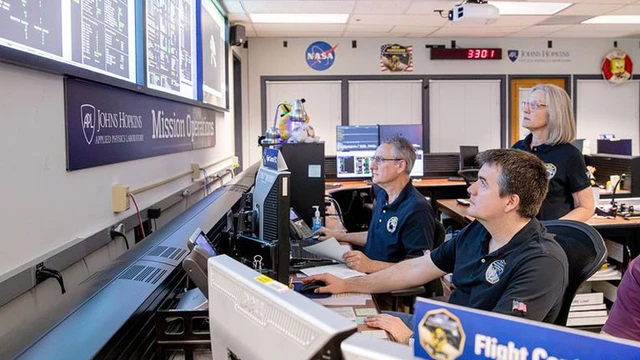
The awakening process on such a scale is a sophisticated technical maneuver. Due to the immense distance, the radio signal took nearly nine hours to reach the Deep Space Network station in Madrid. Now that communication is restored, the team is beginning a phased ramp-up to full power. The first priority is the downlink of system health telemetry, followed by the scientific data accumulated over the past year. Particular attention is focused on the Alice ultraviolet spectrograph: in approximately three weeks, it will begin analyzing the distribution of hydrogen in the outer heliosphere. This is the region where the solar wind, emanating from our star, begins to lose its momentum, yielding to the influence of the interstellar medium.
To ensure stable operations as the probe drifts further from the Sun, NASA has implemented a comprehensive overhaul of its ground-segment software. These updates, which will undergo testing through the end of the year, are designed to streamline mission management and enhance the probe's autonomous efficiency. This is critical, as the output of the radioisotope thermoelectric generator (RTG) powering the craft inevitably declines every year.
The journey of New Horizons is a testament to technological triumph. Launched on January 19, 2006, via an Atlas V 551 rocket, the 478-kg spacecraft became the first in history to explore Pluto, completing its flyby in July 2015. Previously, in 2007, it utilized a Jupiter gravity assist for acceleration, and in 2019, it performed a historic flyby of the Kuiper Belt object Arrokoth. By October 2024, the probe had reached a distance of 60 astronomical units (AU) from the Sun, effectively becoming our advanced outpost on the frontier of the unknown.
Today, New Horizons continues its odyssey, evolving from a planetary explorer into an instrument for studying the very fabric of interstellar space. Every successful awakening and every transmitted bit of data brings us closer to understanding where the influence of our Sun ends and the true infinity of the cosmos begins.
 The Endurance Potential of the Vivo V80 Lite 5G