Migrating a production-grade runtime from one systems programming language to another is typically viewed as a high-stakes operation of staggering complexity. Traditionally, such transitions necessitate months of painstaking manual refactoring and a total freeze on new feature development. The Bun case, however, signals a radical paradigm shift, one where AI agents step in as the primary executors. This precedent proves that, provided there is robust test coverage, AI is capable of rewriting a million lines of code in a matter of days.
Bun’s trajectory has been defined by an uncompromising pursuit of raw performance, a drive that initially led its creators to choose Zig. However, the power of manual memory management brought with it the classic pitfalls of systems programming: use-after-free and double-free errors. The constant battle against unpredictable crashes and the persistent anxiety over system stability became the catalyst for a bold strategic pivot—a complete migration of the codebase to Rust.
The shift to Rust was driven by pragmatism rather than trend-following. In Rust, the concepts of ownership and borrowing shift memory safety verification from runtime to compile-time. What would trigger a production crash in Zig becomes a compiler error in Rust—a failure that simply cannot be ignored during the build process.
The sheer scale of the undertaking was staggering: over 535,000 lines of Zig code required translation. By the most optimistic estimates, a team of engineers would have spent roughly a year on the task, effectively freezing product development. The solution was not a simple "clever prompt," but the deployment of a sophisticated agentic infrastructure.
The bedrock of this transition was a massive TypeScript test suite. Because these tests were written in a high-level language and remained agnostic to the runtime's internal implementation, they served as the "golden standard." A million individual checks guaranteed that if a new Rust version passed the tests, its behavior was identical to the original. This transformed the migration from a manual rewrite into an iterative process of resolving discrepancies.
The execution evolved into a masterclass in agentic engineering. Rather than relying on a single chatbot, the team deployed an army of 64 parallel Claude instances. The primary challenge arose when attempting to decompose the monolith into 100 separate Rust crates; the resulting struggle with cyclic dependencies generated approximately 16,000 compilation errors. For a human developer, this volume of fixes would have been an insurmountable barrier; for a distributed network of AI agents, it was a routine task.
The methodology was meticulously engineered: agents grouped errors by file, verified fixes via cargo check, and operated in isolated loops, avoiding git commits until a full run was completed. Most crucially, the approach to debugging was systemic. When the process failed, developers didn't manually patch the code—they refined the agents' underlying algorithm, optimizing the generation cycle itself.
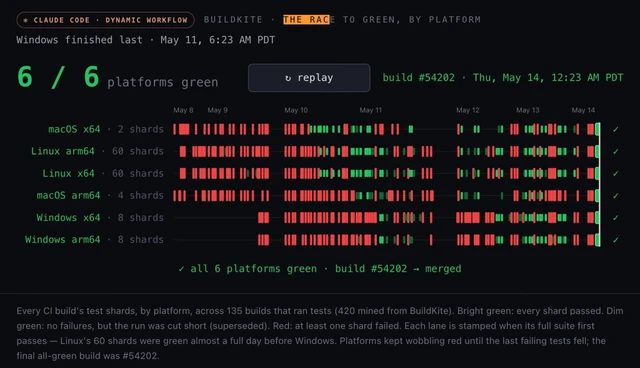
The results were nothing short of staggering. Within 11 days, the number of failing tests plummeted from nearly a thousand files to a handful, eventually hitting zero across all supported operating systems. One million lines of Rust code were integrated into the main branch just six days after the pull request was opened.
Yet, such a breakneck migration came with a cost. An analysis of the new codebase revealed more than 13,000 unsafe blocks. In the Rust ecosystem, unsafe allows developers to bypass strict compiler checks for the sake of performance or low-level API interaction, but an excess of such blocks can negate the language's inherent safety advantages. This suggests that a direct AI-powered port, even one that passes all tests perfectly, can introduce significant technical debt that will require future remediation.
The Bun case serves as a pivotal precedent for the entire industry. It demonstrates that AI is evolving beyond the stage of a "coding assistant" for isolated functions and is becoming a tool for large-scale structural software transformation, compressing migrations that once took months into a matter of days.
 iPhone 17: Dominating the Global Market