The urban landscape, with its concrete jungles and steel skeletons, has long been the primary adversary of wireless connectivity. High-frequency signals collide with physical obstructions, spawning "dead zones" that stifle the full potential of next-generation networks. Solving this challenge requires a paradigm shift: transforming passive walls into active participants in the data transmission process. The concept of "smart skins" for architecture signals a transition toward an infrastructure that does more than merely permit signal passage—it intelligently orchestrates it.
The modern megalopolis is an intricate labyrinth of materials that either absorb or chaotically reflect radio waves. In the heart of dense urban clusters, deep within underground tunnels, or inside sprawling industrial plants, connectivity often falters, creating the notorious "radio shadows." The traditional remedy—deploying additional repeaters and base stations—is both prohibitively expensive and cumbersome. However, researchers from Southeast University in Nanjing have proposed a paradigm shift: transforming the very surfaces of our buildings into an intelligent interface.
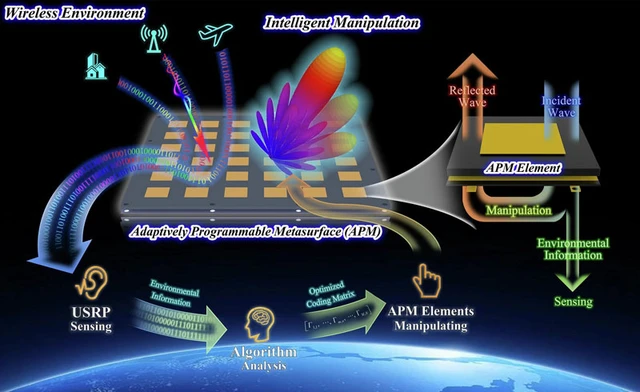
The development, dubbed DISACM (Distributed Integrated Sensing and Communication Metasurface), is a distributed metasurface that integrates the functions of communication and sensing. In essence, it is an engineered electromagnetic material that acts as a "smart skin" for architecture. Unlike a conventional wall, which serves as a static obstacle, this metasurface can programmatically manipulate the phase and direction of reflected radio waves.
Technically, the system operates on the principle of a steerable mirror. It redirects signal energy precisely into areas previously considered "dead zones," creating virtual propagation lobes. This allows the signal not merely to "punch through" obstacles, but to seamlessly circumvent them, optimizing coverage in real-time.
Practical trials in a "smart city" scenario have yielded impressive results. A cascade of ten DISACM modules installed on a building facade increased the Reference Signal Received Power (RSRP) in problematic zones by 10–20 dB. This led to a stable surge in data transmission speeds, reaching up to 400 Mbps under test conditions. Consequently, urban infrastructure ceases to be a passive backdrop and becomes an active tool for network optimization.
Yet, the true potential of this technology lies in its sensing capabilities. The metasurface does more than transmit signals; it analyzes reflected waves, effectively turning a wall into a massive radar sensor. The system can detect human movement and monitor pedestrian flow with a precision of up to 10 centimeters.
This approach fundamentally alters the security paradigm for both industrial and urban environments. Instead of installing hundreds of surveillance cameras or relying on wearable sensors—which can infringe on privacy or require constant charging—the building itself "feels" the presence of a person. This enables the instantaneous detection of personnel in hazardous zones, ensuring a peak level of oversight without the need for direct optical surveillance.
From the perspective of telecommunications evolution, DISACM is a harbinger of the 6G era. While previous network generations focused exclusively on the transmission of data bits, 6G strives for the convergence of communication, sensing, and distributed computing. In this paradigm, the network is no longer just a communication channel—it begins to perceive physical space, transforming the city into a single, responsive organism.
Admittedly, the path to the widespread deployment of "smart skin" will require overcoming several complex hurdles, from the global standardization of protocols to ensuring material durability in harsh urban environments. Nevertheless, the transition from fighting physical obstacles to utilizing them as resources opens a new chapter in the development of wireless systems, where architecture and the digital environment converge into a seamless whole.
 The Phenomenal Battery Life of the Nokia 300 Charge