Modern robotics is pushing beyond the confines of sterile laboratories and urban sidewalks, venturing into the planet's most inhospitable reaches. Yet, extreme temperatures and treacherous terrain remain the primary obstacles for autonomous systems. The Lynx M20S, a cutting-edge Chinese development, is designed to bridge this gap, blending the agility of quadrupedal platforms with the operational efficiency of wheeled transport. Recent high-altitude trials conducted under conditions of extreme cold prove that the industry is now poised to deliver truly resilient tools for high-stakes rescue and scientific missions.
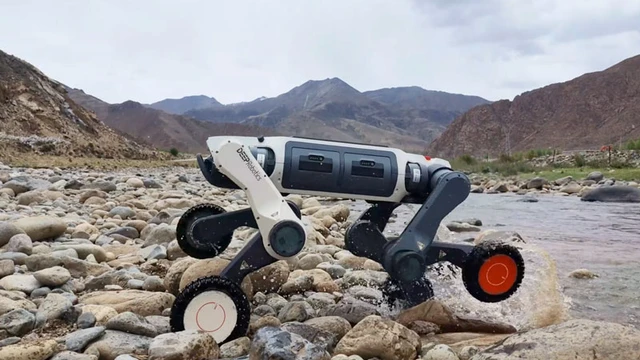
The evolution of mobile robotics has culminated in the rise of hybrid systems designed to resolve the long-standing trade-off between the velocity of wheels and the versatility of legs. The Lynx M20S from DEEP Robotics epitomizes this synergy. The machine is capable of instantaneous mode switching: on flat surfaces, it operates as a four-wheeled platform, significantly optimizing battery consumption and reaching speeds of up to 5 m/s. However, the moment the terrain becomes hostile, its full quadrupedal drive engages.
This transformative capability renders the robot a universal tool for environments where conventional machinery falters. The Lynx M20S confidently navigates staircases with steps up to 25 cm, clears isolated obstacles up to 80 cm in height, and can conquer inclines of up to 45°. In its quadrupedal mode, speed is capped at 2 m/s, ensuring the precision and stability required for traversing rugged terrain.
In terms of payload capacity and energy efficiency, the machine delivers remarkable performance metrics relative to its 35 kg curb weight. The robot is engineered for the sustained transport of payloads up to 15 kg, though it can handle peak loads of up to 50 kg for short durations. Operational endurance scales with the load: unburdened, the Lynx M20S can operate for up to three hours, covering a distance of 15 km. At full nominal capacity (15 kg), runtime decreases to 2.5 hours with a range of 12 km. A critical operational advantage is the support for hot-swappable batteries, which effectively eliminates field downtime that would otherwise require a 1.5-hour standard charging cycle.
The navigation stack transforms the Lynx M20S into a sophisticated instrument for mapping and reconnaissance. Spatial awareness and environment mapping are driven by two 96-line LiDAR sensors, providing a 360° horizontal and 90° vertical field of view. Integrated with wide-angle cameras and an active illumination system, this allows the robot to navigate low-visibility conditions and perform detailed surface analysis.
An IP66-rated chassis guarantees complete dust-tightness and resistance to powerful water jets, enabling the machine to traverse water depths of up to 80 cm. Perhaps its most rigorous test, however, was conducted in high-altitude conditions at 1,000 meters. While the model's rated operating temperature is limited to −20°C, real-world testing demonstrated stable performance in temperatures as low as −30°C.
The ability to function on ice, snow, and in critically low temperatures elevates the Lynx M20S from a mere proof-of-concept prototype to a field-ready instrument. Such resilience opens new horizons for the automated monitoring of inaccessible industrial sites, mountain search-and-rescue operations, and scientific data collection in Arctic or high-altitude zones where human presence entails undue risk.
 The Evolution of the Apple Home Ecosystem