The semiconductor industry is ushering in the Angstrom Era, a period where the battle for every single nanometer dictates global technological hegemony. For years, Intel has struggled to reclaim its lost dominance, weathering relentless pressure from TSMC and Samsung. However, recent pivots in its roadmap signal a decisive strategic overhaul. The company is now fast-tracking the implementation of its most ambitious process node yet—14A—with the goal of redefining the very boundaries of chip density and performance.
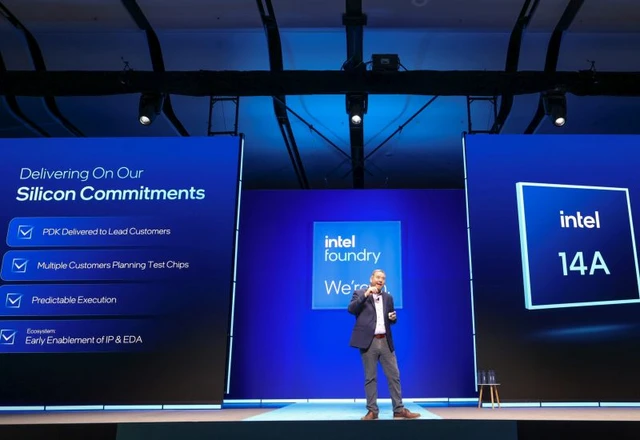
Just a year ago, Intel's leadership maintained a cautious stance, openly hedging its bets on the 14A process should market demand prove insufficient. Today, that narrative has shifted fundamentally. Recent quarterly reports have replaced hesitation with confidence and vague ambitions with concrete deadlines. Intel now intends to bring 14A into volume production by 2028—accelerating its original timeline by a full year.
This acceleration has been made possible by breakthroughs in physical chip characteristics. Internal data suggests that transistor density and performance metrics are currently exceeding even the most optimistic projections. A pivotal factor here is the maturity of the Process Design Kit (PDK)—the essential set of specifications that allows engineers to design chips for a specific process node. Version 0.5 is already available, with version 0.9 slated for release this October. This means external customers can begin full-scale product design as early as this autumn.
The competitive landscape remains intensely pressurized. Taiwan's TSMC also plans to launch its equivalent A14 process in 2028, though its strategy involves a more aggressive update cadence, with intentions to migrate to A13 and A12 nodes by 2029. Meanwhile, South Korea's Samsung is trailing with its SF1.4, targeting mass adoption no earlier than 2029. In this context, Intel is attempting to carve out a window of opportunity by offering a competitive product slightly ahead of the curve or under more favorable terms.
The composition of the customer pipeline is particularly intriguing. While Intel has not officially disclosed its 14A client list, industry signals point to serious interest from major players. Notably, Elon Musk previously confirmed that Terafab—a joint venture pooling resources from SpaceX and Tesla—is eyeing Intel’s 14A technology. Such partnerships are critical for Intel as it strives to evolve from a closed-loop manufacturer into a fully realized open foundry service.
The bedrock of this push toward 14A is the success of its predecessor, the 18A process. In the second quarter, yields and overall output volumes surpassed forecasts. Steady monthly growth in 18A production, coupled with the launch of 18A-P pilot lines, demonstrates that the company has finally overcome its manufacturing efficiency crisis.
The financial dividends of this stabilization are already evident. The unit cost for the Panther Lake processor family has been halved since the start of the year, driven exclusively by quality gains in Intel 18A. Costs are expected to drop another 20% by year-end, significantly boosting margins for the Panther Lake line compared to company averages. Consequently, technological progress in the angstrom era is no longer just a matter of prestige for Intel—it is the primary lever for restoring financial stability.
 The Triumph of 3nm Chip Manufacturing