In an era defined by hyperautomation, the primary bottleneck to operational efficiency is no longer a deficit of technology, but rather data fragmentation and the prevailing semantic gap. For an industrial titan like Toyota, internal linguistic dissonance acts as a "hidden tax" on productivity, creating friction that inevitably slows the pace of vehicle production. The remedy lies in leveraging artificial intelligence to achieve a comprehensive unification of technical terminology across every facet of the organization's business processes. This strategic pivot aims to synchronize the entire product lifecycle—from initial blueprint to final sale—establishing a unified digital governance ecosystem.
Within any global corporation, there exists an invisible barrier: the divergence in how different departments interpret the same concepts. For Toyota, this issue has reached a critical mass, with employees across major divisions spending up to 310,000 man-hours annually simply mapping terms. When planners, engineers, and logisticians speak different "dialects," data must be adapted at 195 distinct stages of the production cycle, creating immense operational friction.
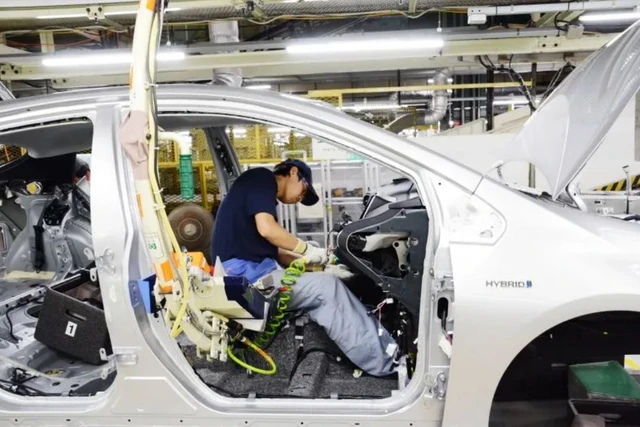
To bridge this gap, the company launched OMUSVI (Organized Master Unified System for Vehicle Information). This is not merely a knowledge base update, but a fundamental restructuring of information exchange. A detailed analysis of business processes revealed a convoluted architecture consisting of 560 sequential steps and 800 disparate systems. In this framework, artificial intelligence serves as the lead linguist and data architect, tasked with distilling a massive library of 45,000 technical terms into a lean, rigorous core of 5,000 concepts.
This radical unification is designed to create a seamless information environment spanning the entire vehicle lifecycle by 2028. By eliminating "semantic noise," Toyota expects to reduce intermediate operations by 30%, significantly accelerating production throughput. The primary technological advantage will be the ability to retrieve the instantaneous, precise status of any vehicle at any point in the system—effectively bringing the company closer to a full-scale digital twin of its entire manufacturing process.
The impact of OMUSVI will extend beyond Toyota’s own plants, rippling through the entire supply chain. Currently, component suppliers spend hundreds of hours manually calculating part volumes when processing corporate production plans. The new AI system will automate these calculations, precisely determining the requirements for every single component and sending pinpointed orders to partners, thereby minimizing errors and optimizing inventory levels.
This internal transformation is unfolding against the backdrop of a tectonic shift in the Japanese automotive industry. Fierce competition from rapidly ascending Chinese brands is forcing players like Honda, Nissan, and Mitsubishi toward consolidation. The standardization of key elements—most notably Electronic Control Units (ECUs)—and the transition to shared software are becoming the only viable means to reduce overhead and maintain competitiveness in an increasingly aggressive global market.
 Anthropic’s Strategic Push for Hardware Independence