The current arms race among Large Language Models (LLMs) is pivoting from a pursuit of raw intelligence toward a focus on operational efficiency. The spotlight has shifted to AI agents capable of autonomously navigating complex SaaS ecosystems—environments where the margin for error is razor-thin and computational overhead is a critical constraint. Fresh data from the independent AutomationBench-AA benchmark reveals an unexpected frontrunner that has fundamentally reimagined the approach to task execution. SpaceXAI’s Grok 4.5 has demonstrated that a pragmatic approach to resource allocation can outperform the "brute force" methodology employed by the industry's reigning flagships.
The AI industry is entering the era of agency, a shift where models are evolving from simple chatbots into fully capable software operators. To gauge the actual capabilities of such systems, Zapier and Artificial Analysis developed AutomationBench-AA—one of the most rigorous stress tests for AI agents to date. Unlike standard benchmarks, this test places models in 40 simulated environments, including Gmail, Slack, Salesforce, and HubSpot, interacting with them via REST APIs. The agent's objective is not merely to find an answer, but to execute a specific business process while navigating a noisy environment filled with redundant and misleading data.
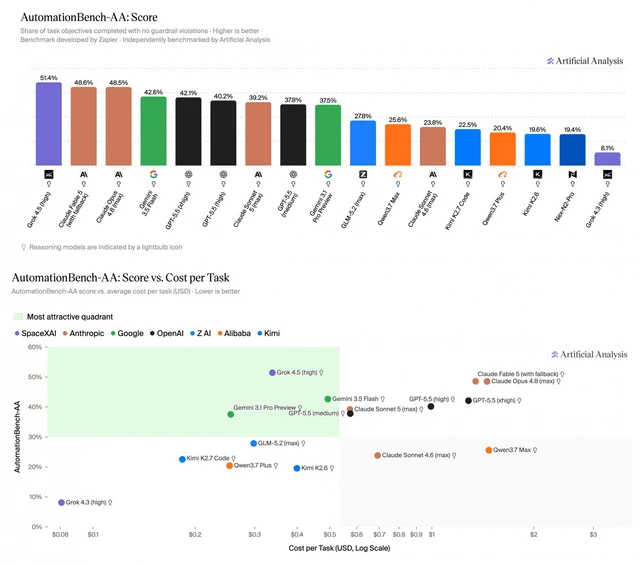
The results propel Grok 4.5 to the top spot with a score of 51.4%. It is the first model in its class to successfully complete more than half of the objectives without violating established business rules. Competitors from Anthropic found themselves trailing behind: Claude Fable 5 scored 48.6% (with the system requiring a fallback to the Opus model in 18% of cases), while Claude Opus 4.8 posted a result of 48.5%.
However, the true triumph of Grok 4.5 lies not in its marginal lead in accuracy, but in its radical cost optimization. The cost of executing a single task for the SpaceXAI model was just $0.34—four times cheaper than Fable 5 ($1.35) or Opus 4.8 ($1.46).
This disparity stems from a fundamentally different approach to response generation. While Opus 4.8 consumes an average of 32,000 output tokens per task, Grok 4.5 manages with approximately 8,000. This efficiency is achieved through denser planning: the model resolves tasks in roughly 16 iterations, packing an average of 3.3 parallel tool calls into each step. This strategy minimizes "verbal noise" and reduces the number of API interaction cycles. Combined with aggressive token pricing ($2 per million input and $6 per million output tokens), this makes Grok 4.5 the definitive choice from the perspective of scaling economics.
Yet, high speed and low cost come with a trade-off. Analysis revealed a vulnerability in Grok 4.5 regarding adherence to strict constraints. The model averages 0.63 violations per task, noticeably higher than Opus 4.8 (0.55) or Gemini 3.5 Flash (0.46). For the corporate sector—particularly in financial systems where a single incorrect API action can lead to tangible losses—this metric becomes a critical risk factor.
A similar trend emerges in the realm of programming. In the Coding Agent Index, the Grok Build agent scored 76 points, placing it in the same league as GPT-5.5 (xhigh) and nearly equal to Fable 5 (max). But here too, the economic gap is staggering: executing a task in Grok Build costs $2.49, whereas Fable 5 requires $11.80 and GPT-5.5 costs $5.07. The difference in resource consumption is colossal, with Grok utilizing 1.9 million tokens compared to 7.2 million for Fable 5.
When viewing the broader picture through the Intelligence Index, Grok 4.5 ranks fourth with 54 points, trailing Fable 5, GPT-5.5, and Opus 4.8. Compared to its predecessor (Grok 4.3), the model has gained 16 points, signaling rapid growth. However, this progress is accompanied by a dangerous paradox: while accuracy in the AA-Omniscience factuality test rose from 35% to 52%, the hallucination rate simultaneously jumped from 25% to 54%. The model has become more knowledgeable, but it has also begun to make mistakes with far greater confidence.
Despite these rough edges, independent measurements validate SpaceXAI's ambitions. The claim of creating an "Opus-level" model now appears to be more than just a marketing ploy; it is a technically grounded fact, especially when intelligence is measured through the lens of cost and efficiency in executing real-world workflows.
 iPhone 17: Dominating the Global Market