Today's handheld gaming market has evolved into a fierce battleground where energy efficiency clashes with raw computational power. The launch of the MSI Claw 8 EX AI+ represents Intel's ambitious bid to shift the balance of power, introducing a solution designed to disrupt AMD's current dominance. At the core of the device is a new platform engineered to redefine the boundaries of what is possible for compact consoles. Yet, this technological leap must contend with a stark market reality: high-end performance comes at a significant premium.
The cornerstone of MSI's new strategy is the Intel Arc G3 Extreme platform, engineered specifically for the handheld segment. This is far more than a mere iterative update; it is a concerted effort to develop specialized silicon capable of challenging the Ryzen Z2 Extreme series. Initial independent benchmarks confirm that Intel has achieved a formidable leap in its graphics subsystem.
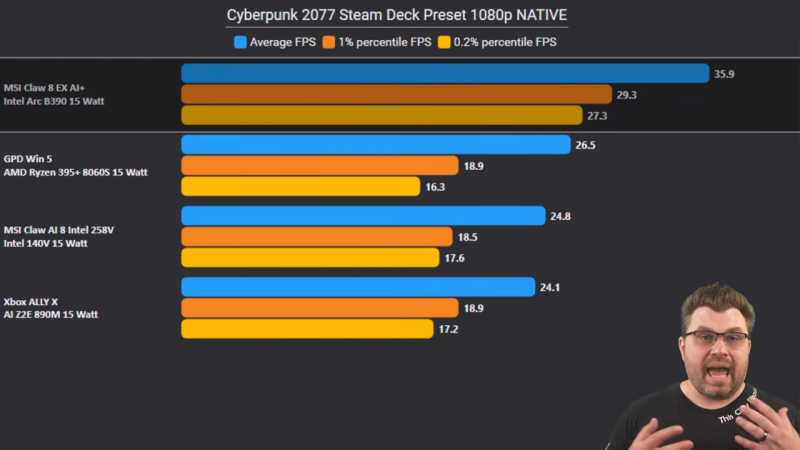
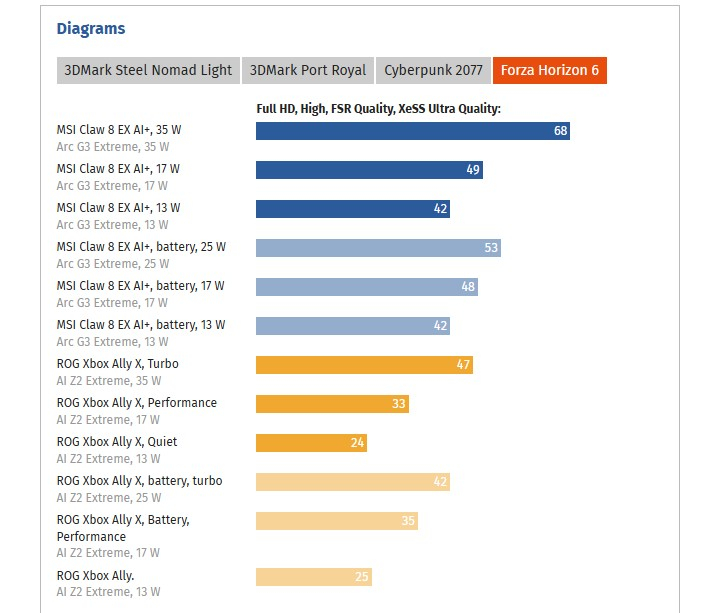
The Intel Arc B390 integrated graphics core is asserting its dominance across both synthetic and real-world scenarios. According to industry lab data, performance gains over Ryzen Z2 Extreme-based solutions—and even the more recent Lunar Lake chips—reach between 50% and 60%. To put this advantage into perspective, consider Cyberpunk 2077: at 1200p resolution with maximum quality settings and 4x frame generation, the handheld delivers approximately 90 FPS. Remarkably, this is achieved in Endurance mode, with CPU power consumption capped at just 14W, underscoring the exceptional efficiency of the new architecture.
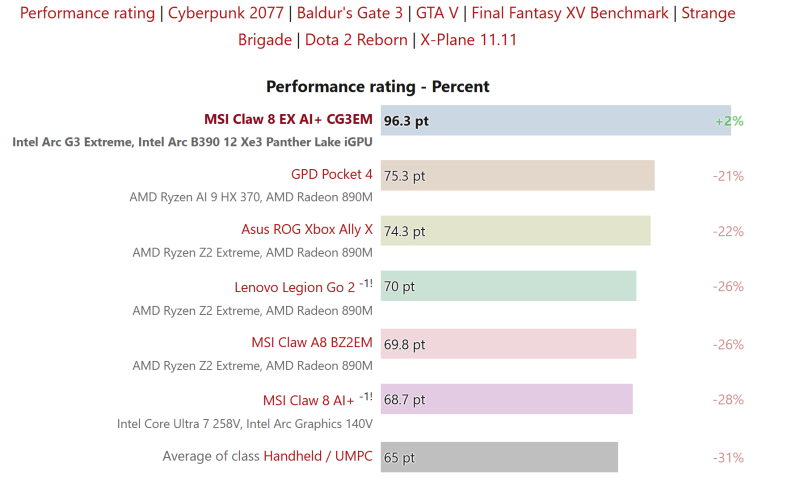
A comparative analysis with other contemporary hybrids reveals a nuanced and intriguing landscape. For instance, the GPD Pocket 4, powered by the Ryzen AI 9 HX 370, still maintains the lead in raw CPU compute power. However, in 3DMark graphics benchmarks, the MSI Claw 8 EX AI+ decisively pulls ahead. In several specialized tests, the Intel Arc G3 Extreme even outperforms the Ryzen AI Max+ 395, effectively elevating the device to a new tier of graphical fidelity for the handheld form factor.
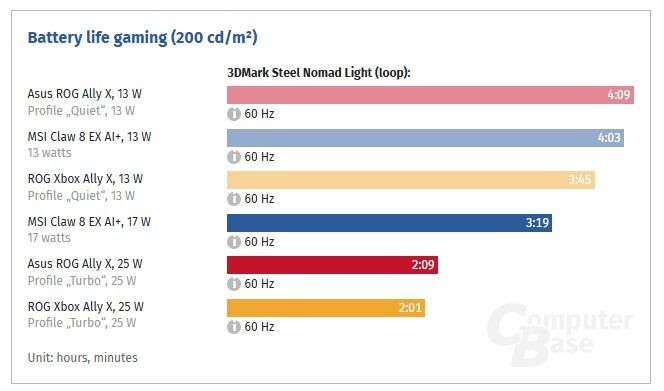
Battery life remains one of the most critical pain points for any handheld device. Operating at a 17W TDP with screen brightness set to 200 nits and a 60Hz refresh rate, the MSI Claw 8 EX AI+ provides roughly 3 hours and 19 minutes of runtime. This figure looks promising when compared to the ROG Ally X at a 25W TDP, where the MSI outperforms its rival by approximately an hour. However, when switching to a more conservative 13W profile, this advantage evaporates, and the device begins to lag behind in terms of single-charge longevity.
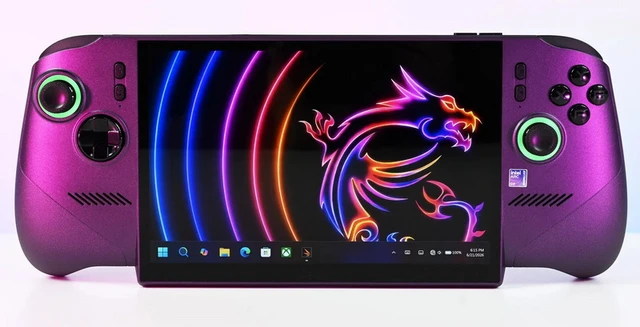
Despite its technical prowess, the product's primary stumbling block is its market positioning. Pricing ranges from $1,699 to $1,799. For this premium, users receive an uncompromising configuration: 32GB of LPDDR5X RAM clocked at 8533 MHz and a 1TB SSD. The issue lies in the absence of more accessible configurations. By eschewing "base" models with lower memory or storage capacities, MSI has transformed the Claw 8 EX AI+ from a mass-market gaming gadget into a niche instrument for enthusiasts willing to pay a premium for absolute technological peak performance.
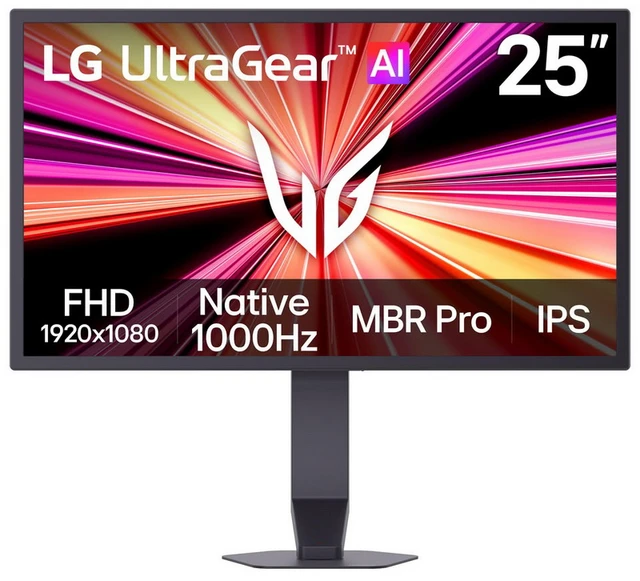 The Speed Frontier: LG UltraGear 25G590B