The boundary between digital leisure and professional development is becoming increasingly porous. Modern academia is beginning to recognize cognitive patterns that, for decades, were dismissed as mere hallmarks of gaming subculture. The University of Silicon Valley is taking a bold leap by transforming gaming achievements into legitimate assets for the admissions process. This initiative reimagines the very concept of mastery, shifting it from the realm of entertainment into the domain of intellectual capital.
In the contemporary pedagogical landscape, there is a growing consensus that traditional assessment methods often fail to capture a student's latent competencies. The University of Silicon Valley has decided to move this thesis from theory to practice by launching a scholarship that effectively institutionalizes "platinum trophies" and 100% game completion as legitimate forms of academic achievement. Consequently, a gamer’s digital profile is now recognized as a substantive addition to their professional portfolio.
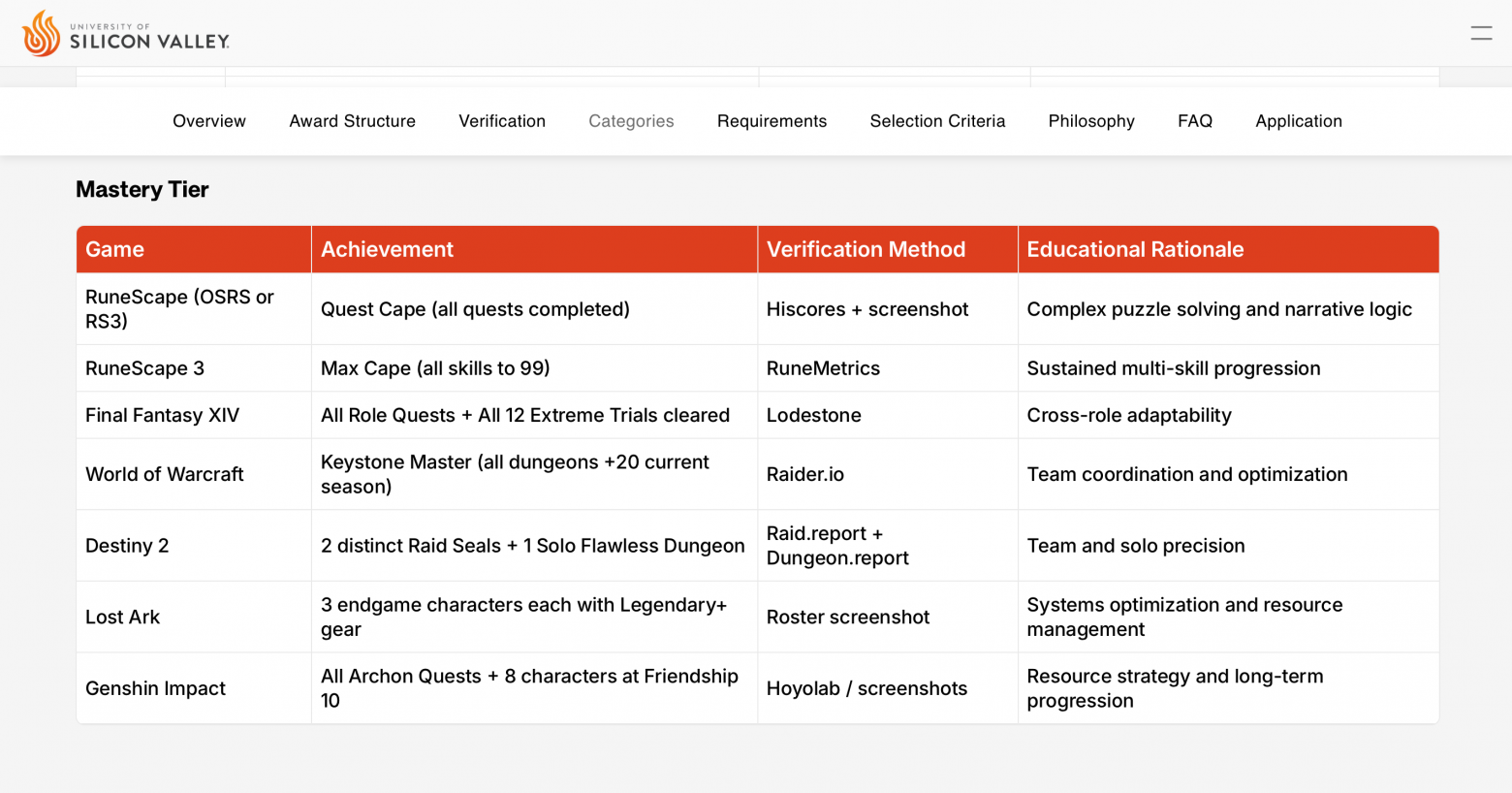
The validation framework spans the industry's largest ecosystems—Steam, PSN, and Xbox—as well as specialized platforms like Hoyolab for Genshin Impact players. The primary criteria for success are rare achievements that demand unrelenting perseverance and strategic foresight. Evidence of mastery can include official trophies or screenshots documenting the full completion of titles across a spectrum of difficulty: from the meditative pace of Stardew Valley and the addictive loop of Vampire Survivors to the brutal trials of the Dark Souls Trilogy and Elden Ring. The latter are particularly prized, as conquering such games requires high stress tolerance and a sophisticated ability to analyze and correct one's own failures.
However, the university is not turning the admissions process into a mere audit of gaming hours. Candidate evaluation is based on a weighted metric where gaming achievements account for 60% of the score. The remaining 40% is split between academic performance (20%) and a deep reflective essay (20%). In this narrative, candidates must articulate their journey toward "platinum," transforming their gaming experience into an analytical post-mortem on overcoming adversity and optimizing solutions.
From an administrative standpoint, the evaluation remains an expert-led process. If a student submits multiple achievements, the university commission selects the highest-tier accomplishment based on internal criteria of complexity and significance. The fiscal framework is equally rigorous: this scholarship can be stacked with other grants, excluding esports-specific funding, provided the total support does not exceed the cost of tuition.
At the heart of this approach lies a fundamental recognition of how modern virtual worlds operate. Mastering complex games is not merely entertainment; it is a rigorous exercise in skills critical for innovators and leaders. This includes the deconstruction of overarching objectives into granular milestones, the optimization of limited resources, systems thinking, and the capacity for autonomous learning under conditions of uncertainty. In essence, the university acknowledges that mastery within a digital environment serves as a proxy for the cognitive discipline required for success in the physical world.

 The Price of Acceleration: CXMT’s Rapid Push into Memory