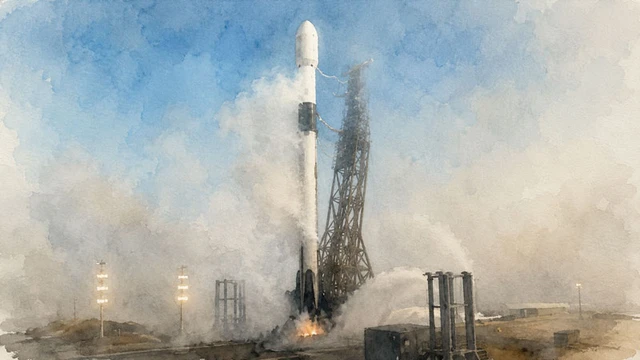
The space industry has long relied on the impeccable performance of the Falcon 9, which has effectively transformed orbital deployment into a routine industrial process. However, a recent incident at Vandenberg Space Force Base served as a sobering reminder of the inherent fragility found even within the most refined control systems. The sudden shutdown of all nine engines mere moments before liftoff was a rare and unsettling anomaly for SpaceX—one that raises critical questions about latent vulnerabilities in the automation of the modern era's most prolific launch vehicle.
The events unfolding at Vandenberg Space Force Base's SLC-4E launch pad followed a sequence that, in the context of modern aerospace, is nearly unprecedented. During preparations for another Starlink V2 Mini deployment, a critical anomaly occurred: all nine first-stage Merlin 1D engines ignited in unison, only to be abruptly terminated by the automated abort system fractions of a second later. The sudden blackout of the livestream and subsequent silence from SpaceX only heightened the tension surrounding the incident, as such anomalies are exceedingly rare for this rocket family.
To grasp the magnitude of the event, one must look at the statistics. The Falcon 9 has become the avatar of space industrialization; this mission was slated to be the family's 667th launch overall and its 85th in 2026 alone. This specific first-stage booster boasted an impressive pedigree of 22 previous missions, including critical government payloads like NROL-145 and USSF-62, alongside a series of commercial OneWeb and Starlink launches. When a system that has demonstrated near-absolute reliability over hundreds of flights falters at the critical moment, it ceases to be a mere technical glitch and becomes a subject of intense forensic analysis.
Of particular concern is the potential systemic nature of these occurrences. A similar incident was recorded during Starship testing just a week prior, suggesting possible complexities within the control algorithms or broader architectural flaws in the launch abort systems. History provides a precedent: on June 14, 2024 (the Starlink 10-2 mission), a comparable failure necessitated the complete replacement of the first stage. In the current instance, SpaceX maintains that both the payload and the rocket block remain intact, offering hope for a rapid turnaround without the need for radical hardware overhauls.
The technical crux of the problem likely resides within the flight computer, which monitors thousands of telemetry parameters in real-time. Should a single sensor detect a deviation from nominal values within a millisecond window, the system triggers an instantaneous shutdown of all engines to prevent a catastrophic failure on the pad. The fact that the vehicle may return to flight almost immediately suggests that engineers have either isolated a software bug or encountered a false-positive sensor trigger. Nevertheless, this episode serves as a stark reminder: even at industrial scale, space remains an environment where the slightest anomaly in code or electronics can halt a multi-ton machine a heartbeat before triumph.
 Nvidia N1X and the New Era of Arm PCs