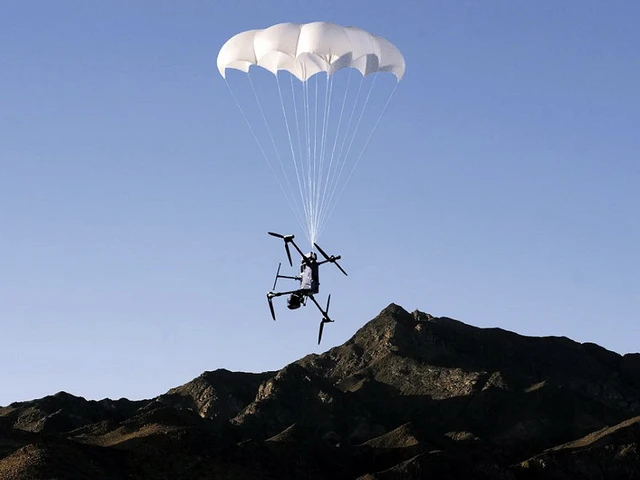
The deployment of heavy-duty commercial UAVs within urban landscapes inevitably brings the issue of safety during critical system failures to the forefront. A ten-kilogram aircraft in freefall effectively becomes a lethal projectile, posing a severe risk to both personnel and property. DJI’s answer to this challenge is the AP100—a specialized parachute recovery system engineered specifically for the Matrice 400 platform. This module elevates safety from a mere optional feature to a mandatory standard, essential for legal operation within strictly regulated airspaces.
When dealing with professional-grade hardware like the Matrice 400, the initial equipment cost is merely one variable in the equation. The far more critical factor is risk management. The implementation of the AP100 system is designed to mitigate the fallout of catastrophic failures, ensuring a controlled descent of the aircraft during emergency scenarios.
The engineering of the AP100 reflects a commitment to maximum compactness without compromising functionality. Weighing less than one kilogram, the module has a negligible impact on the drone's lift capacity, allowing the primary payload to be utilized to its full potential. With an IP55 rating and a broad operating temperature range, the system is purpose-built for the harsh environmental conditions typical of the industrial sector.
The system's primary advantage lies in its exceptional response time. DJI claims that the AP100 can halt rotor rotation and fully deploy the canopy in just 600 milliseconds. In the physics of a heavy object in freefall, this latency is decisive: it allows the descent rate to be reduced to under 5 meters per second before impact. Such performance metrics significantly outperform most third-party solutions, transforming a potentially lethal crash into a controlled incident.
Reliability is anchored in robust autonomy. The AP100 does not rely on the drone's primary computing power; instead, it is equipped with its own dedicated flight controller and Inertial Measurement Unit (IMU). To ensure operational integrity even in the event of a total main battery failure, the module integrates two capacitors that maintain system power for up to one hour.
The recovery process is automated and strictly sequential. Upon activation, an independent flight termination channel instantaneously cuts power to the motors—a critical step that prevents the parachute shrouds from becoming entangled in spinning propellers. Once on the ground, the system activates acoustic and visual beacons for one hour, streamlining the location and recovery of the high-value equipment by ground crews.
From an operational efficiency standpoint, the integration of the parachute requires only minimal adjustments to flight missions. Even under maximum load, total flight time is reduced by a mere six minutes. However, this slight compromise unlocks significant regulatory advantages. Compliance with EASA C5/C6 and UK CAA UK5/UK6 standards allows the Matrice 400 to operate within dense urban environments and perform Beyond Visual Line of Sight (BVLOS) missions within Europe's strictly regulated airspace.
The economic rationale for deploying the AP100 becomes clear when analyzing the numbers. The system's cost of $1,050 is marginal compared to the $10,000+ price tag of the drone itself. In this context, the parachute is not merely an accessory, but a high-efficiency insurance policy capable of safeguarding a company's investment and shielding it from colossal financial and reputational losses in the event of an accident.
 The Global Triumph of Chinese Electric Mobility