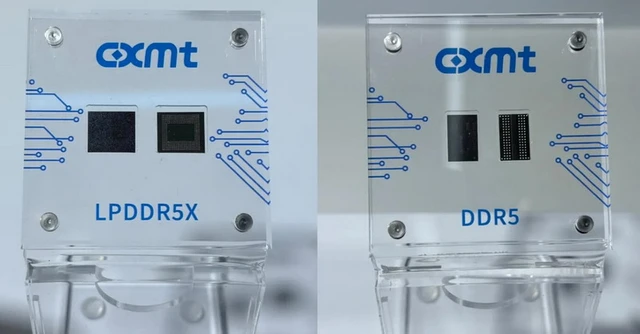
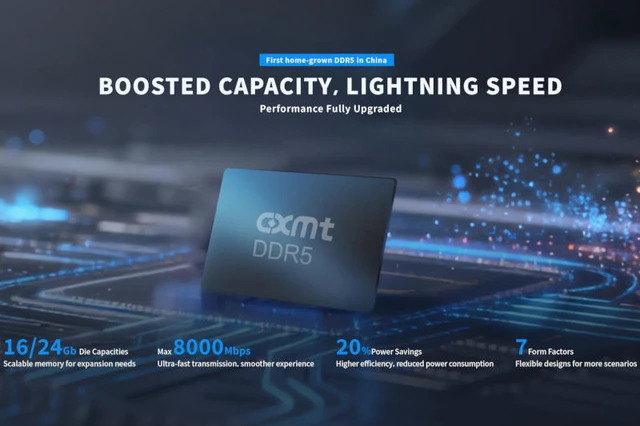
For years, the global semiconductor market has operated as a closed ecosystem dominated by three industry titans. However, the meteoric rise of China’s CXMT is beginning to shift this equilibrium, offering the industry a viable alternative in the DDR5 memory segment. By achieving wafer yields on par with global leaders, the company is evolving from a regional player into a formidable competitor. Amidst critical capacity shortages, such expansion has become a matter of strategic survival for electronics manufacturers worldwide.
In the high-stakes world of semiconductor manufacturing, the primary benchmark for efficiency is "die yield"—the percentage of functional chips harvested from a single silicon wafer. This is where China's CXMT has achieved a quantum leap, pushing its DDR5 production yield to 90%. For context, market leader Samsung operates at approximately 92–93%. Such a narrow margin suggests that CXMT has successfully stabilized highly complex fabrication processes that typically require decades of refinement.
Interestingly, this result was achieved using a 17nm process node, whereas its South Korean counterparts employ denser 10nm lithography. From a technical standpoint, CXMT is prioritizing production reliability and stability over extreme miniaturization. Furthermore, the company is demonstrating phenomenal scaling speed: launching new production lines takes just 12 months, compared to the typical two-year cycle seen among industry incumbents. By the end of this year, CXMT's capacity is expected to reach between 350,000 and 375,000 DRAM wafers per month.
Despite this technological triumph, market acceptance remains ambivalent, heavily influenced by geopolitical headwinds. Major OEMs are adopting a cautious approach toward integrating Chinese memory into their product stacks. Dell has completely purged CXMT components from its supply chain, while HP restricts their use exclusively to devices destined for the domestic Chinese market.
Taiwanese giants Asus and Acer have shown greater flexibility, integrating CXMT memory more frequently into their systems. However, even they tend to localize these solutions primarily within mainland China and select emerging markets. The primary driver of this caution is the risk of alienating the "Big Three"—Samsung, SK hynix, and Micron—who have maintained a virtual monopoly over the DRAM market for decades.
Nevertheless, current market dynamics are beginning to shift in CXMT's favor. The memory supply situation has reached a critical point: the production capacities of the three dominant players are fully booked through 2027. This deficit is forcing PC manufacturers to seek alternative component sources, effectively opening the door for the Chinese manufacturer.
By year-end, CXMT may rival Micron in DDR5 output volumes—a milestone that would be seismic for the semiconductor industry. While precise production forecasts for next year remain confidential, it is evident that the primary output will be directed toward satisfying China's internal demand. This creates a unique scenario where national technological sovereignty becomes a powerful lever of influence on the global high-tech component market.
 The Price of Acceleration: CXMT’s Rapid Push into Memory