Modern electronics demand surgical precision in power distribution, where even the slightest deviation in component tolerances can trigger a catastrophic failure. Recent investigations have uncovered a critical architectural flaw within Gigabyte's GeForce RTX 4060 series that leads to the hardware's literal self-destruction. This is not a matter of improper use; rather, it is a deep-seated systemic defect in the power delivery circuitry. As a result, users are experiencing physical board burnout—a failure often misdiagnosed as being caused by external factors.
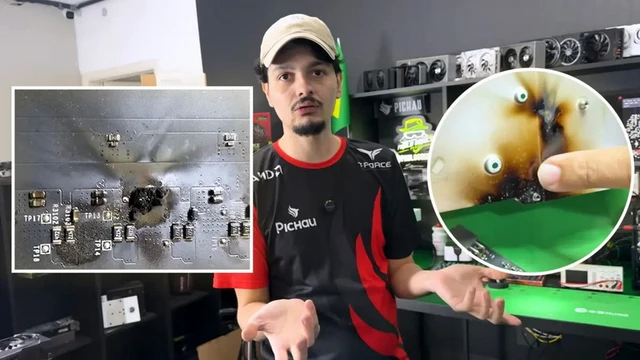
The issue came to light during an analysis of recurring short-circuit failures affecting Gigabyte GeForce RTX 4060 graphics cards. The visual evidence of these failures is alarming: severe charring of the PCB in immediate proximity to the HDMI output. At first glance, the damage resembles a typical external voltage surge delivered via the monitor cable; however, a detailed technical teardown reveals that the root cause lies deep within the GPU's power delivery system.
To understand the nature of this defect, one must look at the operation of the multi-phase Voltage Regulator Module (VRM). Its primary function is to efficiently distribute the electrical load across several parallel power stages, ensuring that no single MOSFET operates at its absolute limit. In an ideal system, these phases operate with synchronous switching frequencies and identical duty cycles, ensuring a uniform current flow. A comparative analysis against reference samples from other manufacturers—such as Inno3D—demonstrated a stable signal of approximately 207 kHz across all phases.
In the case of the Gigabyte cards, the situation is starkly different. Oscilloscope measurements revealed a critical imbalance: the frequency of one phase fluctuated erratically between 150 and 300 kHz, while the remaining phases exhibited instability. This points to a serious engineering error in the selection of resistor and capacitor values within the current sensing circuit and the PWM controller management.
When the controller receives inaccurate current data due to improperly spec'd components, it fails to balance the load effectively. Consequently, specific MOSFETs begin to operate under overload conditions, inevitably leading to overheating and subsequent dielectric breakdown. This results in a short circuit accompanied by a massive release of thermal energy. Because one of the power stages is physically positioned close to the video outputs, this thermal destruction spreads toward the HDMI port, creating the illusion of an external electrical strike.
This technical quirk creates a significant predicament for consumers: seeing a charred connector, a manufacturer may interpret the failure as a result of improper use and deny warranty claims. In reality, however, this is a latent design flaw introduced during the engineering or assembly phase.
The possibility of rectifying the defect was confirmed through extensive modification of a damaged board. By removing the incorrect current-sensing components and replacing them with reference values, synchronized operation across the remaining power phases was restored. The addition of higher-rated MOSFETs and the implementation of a fuse on the 12V input allowed the graphics card to successfully pass stress tests and return to operational status.
While the exact scale of the problem remains unknown, the documented cases involve devices manufactured in 2023. This incident underscores the critical importance of rigorous component quality control, even in mass-market products, as a single incorrect resistor can transform a high-tech device into a potential fire hazard.
 The Phenomenon of Chinese 96GB AI Accelerators