Conquering the Moon demands more than just raw propulsion; it requires a sophisticated, airtight system for traffic management. As cislunar space evolves into a bustling transit hub, the potential for accidental collisions and navigational anarchy has become a critical concern. Establishing a comprehensive orbital waypoint around the Moon inevitably necessitates the formulation of rigorous "rules of the road" for deep space. Researchers are currently laying the mathematical groundwork for a future space traffic control system designed to guarantee the safety of routine interplanetary transit.
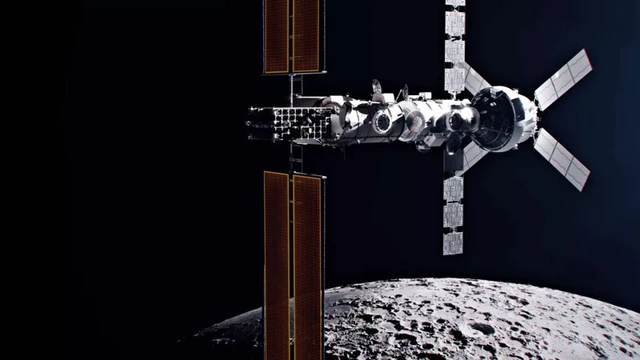
The vision of a lunar-orbiting station, exemplified by the Gateway project, remains a strategic priority despite shifts in NASA's current roadmap. What began as an ambitious concept is evolving into a critical infrastructural necessity: a primary hub for cargo and crew bound for the lunar surface. However, as flight frequency increases, a fundamental challenge emerges: how to coordinate the movement of multiple spacecraft within an incredibly complex gravitational environment.
To address this, researchers from Texas A&M University, the Lyndon B. Johnson Space Center, and Purdue University have developed a comprehensive mathematical model for spacecraft flow management. In essence, this represents the first comprehensive "traffic code" for a lunar airport, designed to eliminate the risk of catastrophic errors when multiple assets converge on a single docking point.
Central to this system is the utilization of a Near-Rectilinear Halo Orbit (NRHO). This trajectory is a highly eccentric ellipse: the station passes within just 1,600 km of the Moon's north pole before swinging out to nearly 64,000 km above the south pole. The choice of NRHO is driven by pragmatism; such an orbit ensures stable communication with Earth and requires minimal fuel for station-keeping. Yet, this is precisely where the primary difficulty lies—the dynamic interplay between the gravitational fields of the Earth and the Moon creates an unstable environment, making the management of multiple converging objects an energy-intensive and high-risk operation.
In terrestrial aviation, an aircraft can circle in a holding pattern or divert to an alternate airport while awaiting landing clearance. In deep space, such luxuries do not exist. Spacecraft are in a state of perpetual motion, and any deviation from the flight path can result in the loss of the asset or a collision. Docking sequences can span hours, days, or even weeks, demanding surgical precision in orbital calculations.
To overcome this challenge, the researchers proposed a "string of pearls" concept. Under this model, spacecraft awaiting their turn to dock are positioned on the same orbit as the station, maintained at precisely calculated intervals—either ahead of or behind the primary hub.
This formation is achieved through relative orbit control algorithms. Rather than relying on absolute coordinates relative to the Earth or Moon, the system tracks the position of each spacecraft relative to the station itself. This allows for a series of short, frequent trajectory corrections, minimizing fuel consumption and transforming chaotic rendezvous into a predictable, orderly process.
While specific station architectures may evolve, the principles established in this research remain universal. This traffic management model effectively serves as a prototype for a future cislunar air traffic control service. It is a pivotal step toward transforming the Moon from a destination for rare expeditions into a permanent economic and scientific outpost for humanity.
 SpaceX’s Hundred-Billion Dollar Leap into Louisiana