Humanity has grown accustomed to viewing the impact of solar activity as a challenge exclusive to the era of satellites and global networks. Yet, the first collisions between technology and space weather occurred much earlier, during the age of steam and the telegraph. A recent historical investigation has pinpointed the date of one of the first recorded disruptions on England's railways—a case that underscores the fundamental vulnerability of expansive electrical systems when faced with geomagnetic storms.
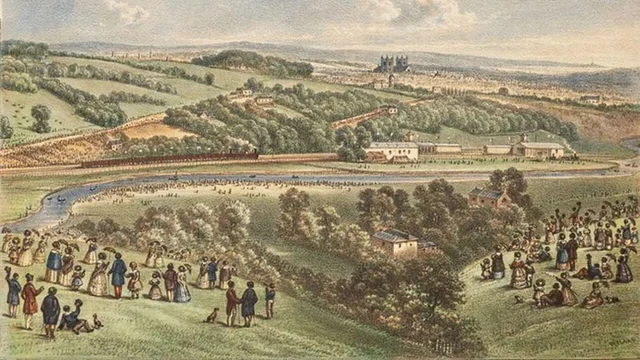
The intersection of human technology and solar activity dates back much further than is commonly believed. For years, the scientific consensus held that the first documented instance of space weather impacting transport infrastructure occurred on October 18, 1841. The event involved a failure of the electric telegraph on a railway near Exeter, where signaling issues delayed a train's departure by 16 minutes because operators could not confirm that the line to Starcross station was clear.
However, a recent retrospective analysis conducted by an international team of researchers led by Lancaster University uncovered a fundamental chronological error. It emerged that the railway line where the incident took place did not even open until 1846. Consequently, the event could not have physically occurred in 1841; the historical record was simply the result of a regrettable typo.
To reconstruct the true timeline, the scientists adopted a forensic approach, cross-referencing archival timetables, period newspaper clippings, sunspot data, and aurora observations. An analysis of geomagnetic records from the Greenwich Observatory revealed that a severe disturbance began around 21:20 on October 18, 1848. This date is now accepted as the correct one, transforming the "mystery of 1841" into a verified fact of 1848.
From a technical standpoint, the failure mechanism was a textbook example of a geomagnetic storm. When Earth's magnetic field is subjected to intense solar influence, changes in magnetic flux generate an electric field across the planet's surface. In extended conductive paths—such as telegraph lines and signaling systems—this creates what are known as geomagnetically induced currents (GICs). These induced currents penetrated the equipment directly, creating false electrical pulses that operators interpreted as genuine signals or led to total system failure.
Interestingly, once the Exeter date was corrected, the incident ceased to be the first of its kind. Researchers discovered that in March 1847, operators on the Midland Railway also reported "spontaneous currents" in their equipment, coinciding with a vivid aurora. As a result, the Midland Railway incident is now officially recognized as the earliest confirmed example of space weather impacting the technosphere.
This historical detour has direct implications for contemporary safety. Today, geomagnetically induced currents still pose a risk to rail signaling systems, as they can trigger dangerous false activations of semaphores. Given the scale of modern infrastructure in the UK, where tens of thousands of signaling circuits are operational, major solar flares are treated as a significant risk factor.
The Exeter train incident reveals a sobering pattern: the challenge of space weather emerged almost simultaneously with the deployment of the first large-scale electrical networks. Nearly two centuries later, despite colossal leaps in electronics, humanity continues to grapple with the same fundamental vulnerability of its systems in the face of solar activity.
 The 5,000-Day Milestone of Martian Exploration