The global AI arms race has decisively shifted its center of gravity from algorithmic sophistication to the realm of silicon. The geopolitical friction between the United States and China has triggered a tectonic shift in semiconductor supply chains, transforming "import substitution" from a political slogan into a stark economic imperative. We are now witnessing the emergence of closed ecosystems, where established Western standards are increasingly supplanted by localized solutions. This transition signals the end of an era defined by the absolute monopoly of a single player in the world's largest market.
Jensen Huang’s public assertions that U.S. sanctions have effectively erased Nvidia's presence in China are, for the most part, rhetorical. The reality is far more nuanced and multifaceted. According to analytical data from TrendForce, Western suppliers still maintain approximately 21% of the Chinese AI accelerator market—though this figure represents a precipitous decline from last year, when the combined share of AMD, Nvidia, and other foreign vendors stood at 34%.
The erosion of Western dominance is being driven by a dual-pronged assault. On one side are the stringent U.S. export restrictions; on the other is Beijing’s state-driven strategy to accelerate the transition to domestic alternatives. The situation surrounding the Nvidia H200 accelerators serves as a textbook example of this "double barrier": despite receiving formal clearance from U.S. regulators, Chinese customs blocked the equipment's entry. This signals that the PRC is no longer willing to rely on "downgraded" versions of Western silicon, preferring instead to cultivate its own proprietary technology stacks.
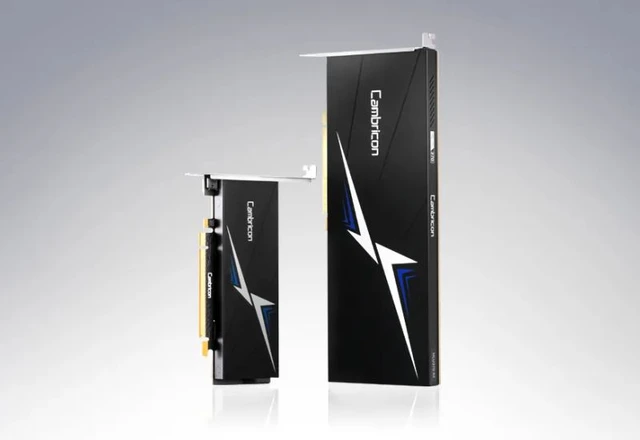
Internally, a two-tiered production ecosystem has emerged. The first tier consists of independent vendors, such as Huawei and Cambricon, whose market share is projected to climb from 46% to 56% this year. The second tier comprises tech giants developing chips for internal consumption. ByteDance, via its Kunlunxin division, and Alibaba, through T-Head, are aggressively consolidating their positions, expanding their market presence from 20% to 23%.
This shift mirrors a global paradigm established by the West's largest cloud service providers. Google, Amazon, Microsoft, and Meta have long pivoted toward designing their own Application-Specific Integrated Circuits (ASICs) to mitigate vendor lock-in and optimize power efficiency for specific AI workloads. Chinese tech giants are essentially following this blueprint, albeit under significantly higher external pressure.
On a global scale, the AI server market continues to experience exponential growth, expanding by more than 28% annually. Nvidia remains the dominant force worldwide, controlling 64% of shipments, while AMD holds a modest 8.6%. However, long-term forecasts suggest a gradual erosion of this hegemony; by 2027, the aggregate share of Chinese manufacturers in the global market is expected to reach 20%.
Nevertheless, the trajectory toward technological autonomy will not be linear. The primary risks to the industry's stability are not so much the technical hurdles of lithography, but rather geopolitical turbulence and trade wars. Customs tariffs and new sanctions packages could either stifle the expansion of Chinese chips or, conversely, serve as a catalyst for the creation of a fully vertically integrated production cycle within the PRC.
 The Evolution of the Apple Home Ecosystem