The global race for reusable launch vehicles is no longer the exclusive province of American private enterprises. China is aggressively mastering vertical landing capabilities, aiming to drastically slash the cost of orbital access and establish a viable counterweight to Western industry standards. At the forefront of this technological surge is LandSpace and its ambitious ZhuQue-3 project. The upcoming launch will serve as a critical litmus test for Beijing's ability to translate state-led achievements into private sector scalability.
The modern commercial space market presents an uncompromising ultimatum: a rocket must either become reusable or remain an expensive, inefficient relic of the last century. Within this landscape, the Chinese firm LandSpace is vying for a seat at the high table with the development of the ZhuQue-3—a launch vehicle that serves as the conceptual and functional counterpart to SpaceX’s Falcon 9.
The technical specifications of the ZhuQue-3 are formidable: standing 66 meters tall, the rocket is capable of delivering a payload of up to 18,300 kg into Low Earth Orbit (LEO). However, the primary technological challenge—and its most significant differentiator—lies in its propulsion system. By utilizing methalox (liquid methane and liquid oxygen) engines, LandSpace aligns itself with the industry's most cutting-edge developments. Methane not only provides superior efficiency but also significantly streamlines the refurbishment process for reuse, as it produces far less carbon soot (coking) within the engine compared to traditional kerosene.
The road to success has been fraught with challenges. The ZhuQue-3’s previous operational experience left a mixed track record: while the second stage successfully reached orbit, the first stage failed, ending its descent in an explosion during the landing attempt. This incident underscored the immense complexity of managing the reentry dynamics of a multi-ton structure as it plunges from space into the dense layers of the atmosphere.
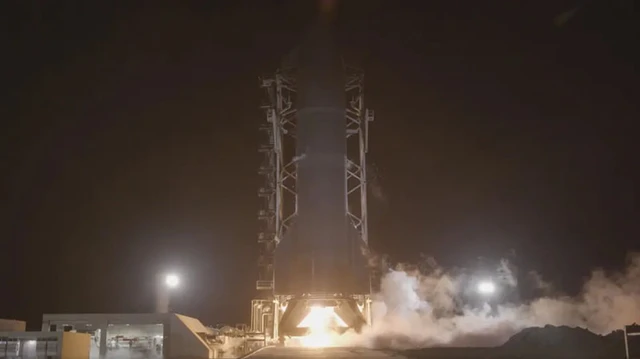
Preparations for the upcoming launch from the Jiuquan Satellite Launch Center in northwest China have been conducted under a regime of rigorous technical validation. In late June, the company executed a series of static fire tests, confirming the nominal operation of all systems and the seamless coordination of its components. These tests established the foundation for the August launch, where the primary objective is not merely payload delivery, but the safe recovery of the booster.
China’s strategy for mastering reusability is evolving along two parallel tracks: state-led and private. While LandSpace is pursuing the classic vertical landing approach, state programs are experimenting with more exotic methodologies. For instance, the success of the Long March 10B was achieved via a net-capture system—a method that minimizes the precision requirements for the stage's own landing by shifting part of the operational burden to ground infrastructure.
Ultimately, the upcoming flight of the ZhuQue-3 is more than just another mission; it is a pivotal milestone in the evolution of China’s private space sector. A successful mission will validate the viability of methalox technology and demonstrate the ability of Chinese commercial entities to engineer complex autonomous recovery systems—a development that will inevitably intensify competition across the global launch services market.
 The Phenomenon of the Supermassive Galaxy IC 1101