The scramble for resources at the lunar south pole has emerged as one of the defining technological frontiers of our era. The discovery of water ice within permanently shadowed craters could transform Earth's natural satellite into a strategic launchpad for deep-space exploration. The ambitious Chang'e-7 mission was poised to be a cornerstone of this expansion; however, an abrupt halt in preparations has laid bare the inherent fragility of aerospace schedules. The global community must now wait until next year for a resolution, pending the alignment of celestial mechanics to once again provide a favorable window.
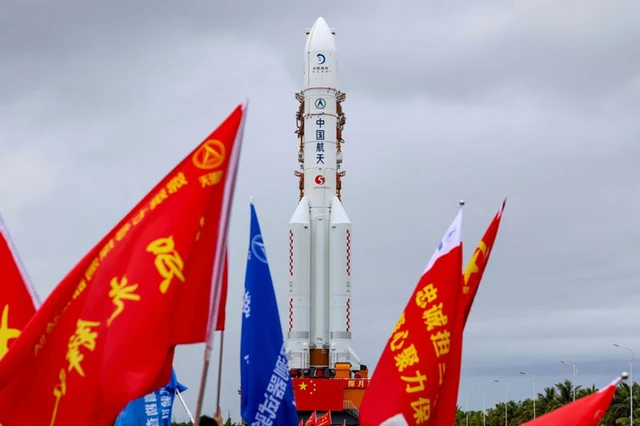
The Wenchang Spacecraft Launch Site stood poised for the ascent of the Long March 5 Y14. All systems were nominal, the payload had been positioned vertically since mid-August, and the final countdown seemed a mere formality. Yet, in a sudden turn of events, the Chang'e-7 mission was scrubbed, with a return to the launch pad now unlikely until next year.
Initial reports attributed the setback to atmospheric volatility—a typhoon raging near Hainan, a frequent critical failure point for heavy-lift rockets. However, an official statement from the Chinese space agency provided a more nuanced explanation: the mission "did not meet the launch conditions for the window scheduled for this year." In the realm of astrodynamics, this implies a misalignment of critical variables, ranging from the relative positions of the Earth and Moon to the precise angle of solar incidence at the intended landing site.
The unique environment of the lunar south pole imposes stringent constraints on mission planning. Unlike equatorial regions, lighting here is sparse and erratic. A successful touchdown and subsequent operational phase require a flawless convergence of orbital trajectory and specific lighting regimes. Even a minor scheduling shift of a few days due to inclement weather can cause the launch window to slam shut, delaying the next viable opportunity by several months.
The technological architecture of the Chang'e-7 mission is impressively complex and multi-layered. This is not merely the delivery of a single module, but the deployment of an entire integrated research complex, comprising an orbiter, a landing platform, and a specialized lunar rover. The centerpiece of this innovation, however, is the "hopping" probe—a unique vehicle designed to traverse the boundary between illuminated zones and regions of eternal shadow.
The primary objective of this exploration is the Shackleton crater and other Permanently Shadowed Regions (PSRs), where temperatures are so extreme that water may have existed as ice for billions of years. It is here that the hopping module is tasked with direct sampling and soil analysis—objectives virtually impossible for conventional wheeled rovers due to the risk of becoming bogged down and the total absence of solar power.
While the delay is undoubtedly frustrating, it underscores a fundamental truth of space exploration: when pitted against the laws of physics and orbital mechanics, human planning always takes a backseat. China remains committed to the establishment of a full-scale lunar base, but the journey now demands a greater measure of patience.
 The End of the Falcon 9 Era